Learn what every symbol on the card means.Full credits and sources at beakbrain.com/symbols
 WetlandCavity nestLarge · 843 g


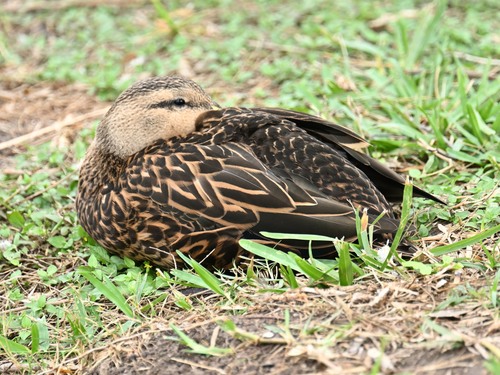
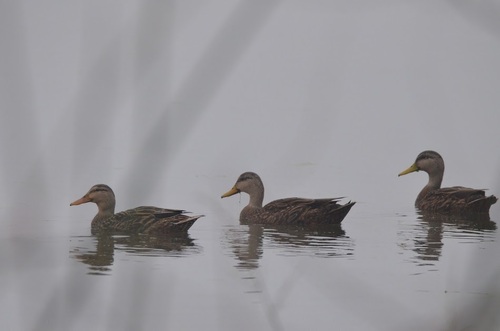
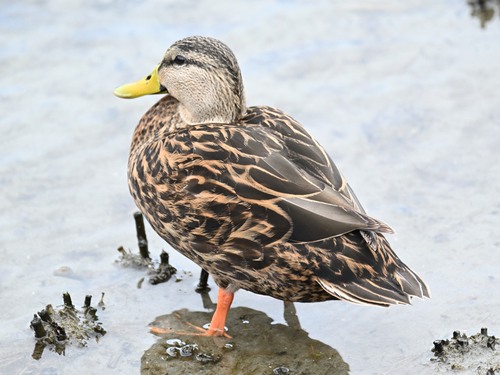
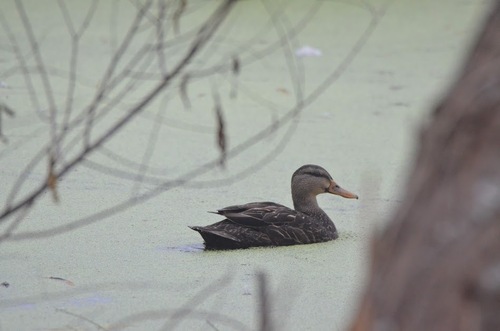
ID tip
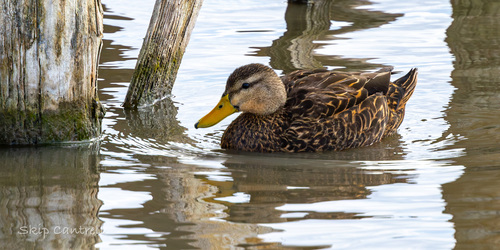
The adult mottled duck is 44 to 61 cm (17–24 in) long from head to tail. It has a dark body, lighter head and neck, orange legs and dark eyes. Both sexes have a shiny green-blue speculum (wing patch), which is not bordered with white as with the mallard. Males and females are similar, but the male's bill is bright yellow, whereas the female's is deep to pale orange, occasionally lined with black splotches around the edges and near the base. The plumage is darker than in female mallards, especially at the tail, and the bill is yellower.
Text from Wikipedia, licensed CC BY-SA 4.0.
When to see the Mottled Duck
One bar for each month. Filled bars are the 10 months with records; pale bars are months with none. The wide bar is April, the month with the most records.
Where to see the Mottled Duck
The map shades 3 countries with regular records, and 1 more in a lighter tone where the bird turns up only as a stray. Everything unshaded has no records. Countries are listed below the map.
Recorded as a rare visitor in Canada.
About the Mottled Duck
The mottled duck or mottled mallard is a medium-sized species of dabbling duck. It is intermediate in appearance between the female mallard and the American black duck. It is closely related to those species, and is sometimes erroneously considered a subspecies of the former.
Text adapted from Wikipedia, licensed CC BY-SA 4.0.
Easily confused with
 Grey TealAnas gracilisIt is identified by the presence of a crimson coloured iris in its eyes, which is relatively more prominent in adult males.
 Chestnut TealAnas castaneaThe chestnut teal is darker and a slightly bigger bird than the grey teal.
 Indian Spot-billed DuckAnas poecilorhynchaThis duck is around the same size as a mallard and has a scaly patterned body with a green speculum bordered by white.
Side by side: Mottled Duck vs Northern Pintail · American Black Duck vs Mottled Duck · Mottled Duck vs Pacific Black Duck · Mottled Duck vs Muscovy Duck · Grey Teal vs Mottled Duck · Chestnut Teal vs Mottled Duck · Indian Spot-billed Duck vs Mottled Duck
Learn the Mottled Duck in the BeakBrain App
Photo and call practice. Coming soon to iPhone and Android.
Play today's Daily BirdEvery photo and recording on this page is credited to its author under the licence shown. Spotted a problem with this page, or have a better photo? Contribute.