Learn what every symbol on the card means.Full credits and sources at beakbrain.com/symbols
 WetlandCavity nestLarge · 488 g



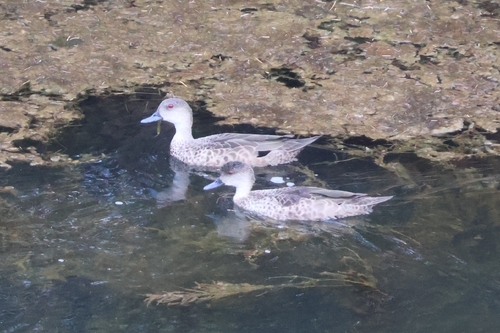
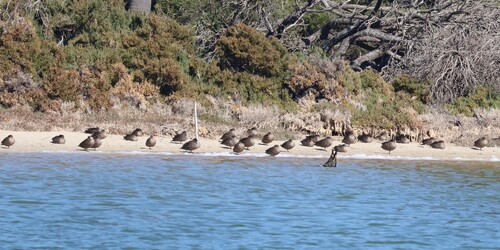
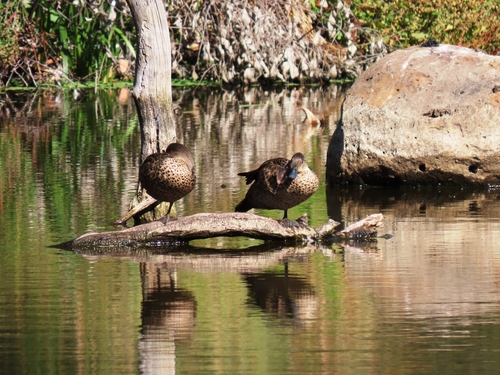
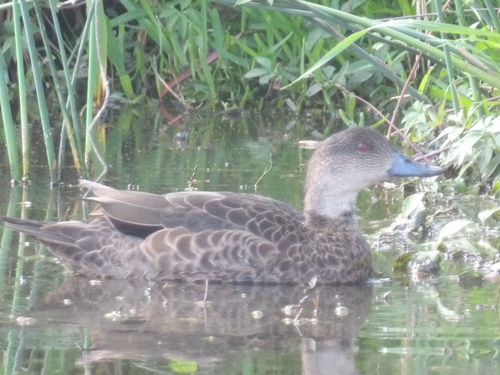

ID tip
It is identified by the presence of a crimson coloured iris in its eyes, which is relatively more prominent in adult males. It is a mottled brown duck with white and green flashes on its wings. Males and females share the same colouration, in contrast to the related chestnut teal, male and female of which are strikingly different. The grey teal has almost identical colouration to the female chestnut teal and the grey can only be distinguished by its lighter coloured neck and paler face. Juveniles are paler than adults, especially on the head. Voice: The call of the grey teal can be heard as a cuck, cuck, cuck that is relatively rapid and includes a sharp whistle. The male and female calls are different in terms of volume and type. The male's call tends to be more of a whistle, whereas the female's call is very loud and harsh sounding. For short-distance communication, the birds have a softer variation of their calls.
Text from Wikipedia, licensed CC BY-SA 4.0.
When to see the Grey Teal
One bar for each month, and every month is filled: this bird is recorded here in all twelve. The wide bar is October, the month with the most records.
Where to see the Grey Teal
The map shades 6 countries with regular records. Everything unshaded has no records. Countries are listed below the map.
About the Grey Teal
The grey teal is a dabbling duck found in open wetlands in Australia and New Zealand.
Text adapted from Wikipedia, licensed CC BY-SA 4.0.
Easily confused with
 Mottled DuckAnas fulvigulaThe adult mottled duck is 44 to 61 cm (17–24 in) long from head to tail.
 Chestnut TealAnas castaneaThe chestnut teal is darker and a slightly bigger bird than the grey teal.
 Indian Spot-billed DuckAnas poecilorhynchaThis duck is around the same size as a mallard and has a scaly patterned body with a green speculum bordered by white.
Side by side: Grey Teal vs Pacific Black Duck · Grey Teal vs Mottled Duck · Chestnut Teal vs Grey Teal · Grey Teal vs Indian Spot-billed Duck
Learn the Grey Teal in the BeakBrain App
Photo and call practice. Coming soon to iPhone and Android.
Play today's Daily BirdEvery photo and recording on this page is credited to its author under the licence shown. Spotted a problem with this page, or have a better photo? Contribute.