Learn what every symbol on the card means.Full credits and sources at beakbrain.com/symbols
 WetlandCavity nestLarge · 624 g


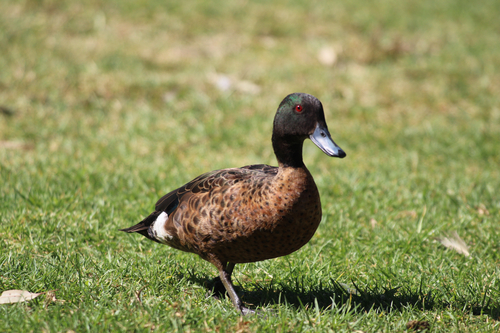
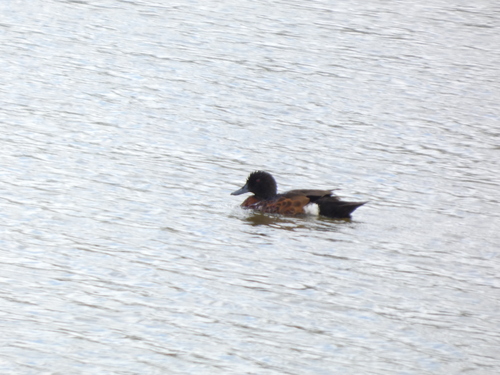
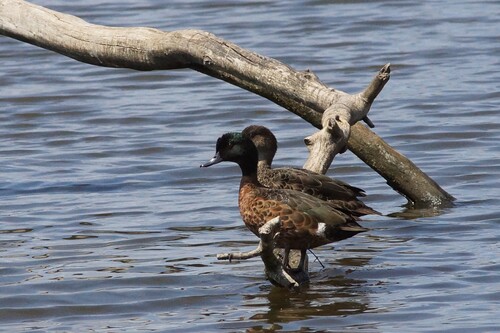
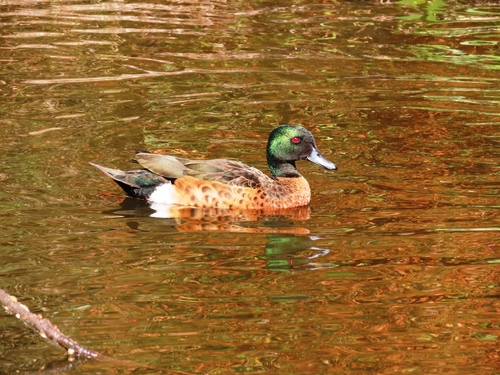
ID tip
The chestnut teal is darker and a slightly bigger bird than the grey teal. The male has a distinctive green coloured head and mottled brown body. The female has a brown head and mottled brown body. The female is almost identical in appearance to the grey teal. The female chestnut teal has a loud penetrating "laughing" quack repeated rapidly nine times or more.
Text from Wikipedia, licensed CC BY-SA 4.0.
When to see the Chestnut Teal
One bar for each month, and every month is filled: this bird is recorded here in all twelve. The wide bar is January, the month with the most records.
Where to see the Chestnut Teal
The map shades 3 countries with regular records, and 6 more in a lighter tone where the bird turns up only as a stray. Everything unshaded has no records. Countries are listed below the map.
Recorded as a rare visitor in Germany, Spain, United Kingdom, Sweden, Portugal, United Arab Emirates.
About the Chestnut Teal
The chestnut teal is a dabbling duck found in Australia. It is protected under the National Parks and Wildlife Act 1974.
Text adapted from Wikipedia, licensed CC BY-SA 4.0.
Easily confused with
 Indian Spot-billed DuckAnas poecilorhynchaThis duck is around the same size as a mallard and has a scaly patterned body with a green speculum bordered by white.
 Yellow-billed DuckAnas undulataThese are mallard-sized mainly grey ducks with a darker head and bright yellow bill.
 Eastern Spot-billed DuckAnas zonorhynchaThis duck is around the same size as a mallard and has a scaly patterned body with a blue speculum.
Side by side: Chestnut Teal vs Pacific Black Duck · Chestnut Teal vs Mottled Duck · Chestnut Teal vs Grey Teal · Chestnut Teal vs Harlequin Duck · Chestnut Teal vs Indian Spot-billed Duck · Chestnut Teal vs Yellow-billed Duck · Chestnut Teal vs Eastern Spot-billed Duck
Learn the Chestnut Teal in the BeakBrain App
Photo and call practice. Coming soon to iPhone and Android.
Play today's Daily BirdEvery photo and recording on this page is credited to its author under the licence shown. Spotted a problem with this page, or have a better photo? Contribute.