Learn what every symbol on the card means.Full credits and sources at beakbrain.com/symbols
 WoodlandCup nestSmall · 20 g


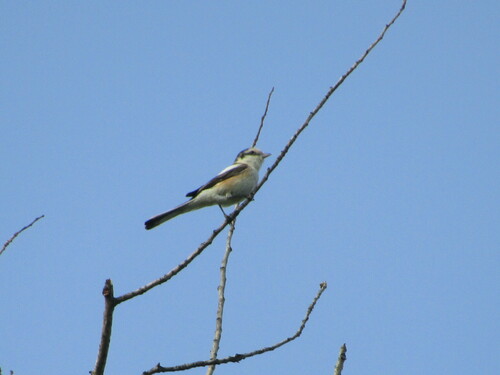
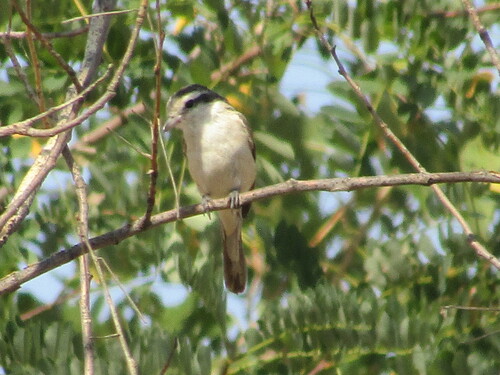
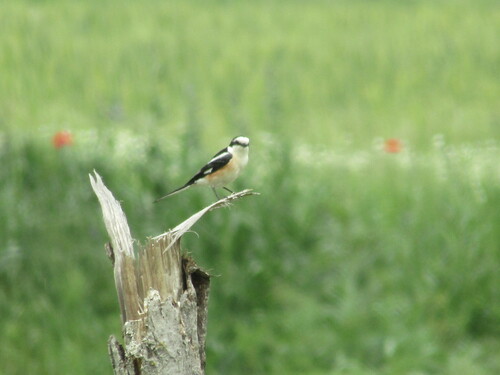
ID tip
The masked shrike is the smallest of its genus, a slender bird which usually weighs 20–23 g (0.71–0.81 oz), measuring 17–18.5 cm (6.7–7.3 in) long with a 24–26.5 cm (9.4–10.4 in) wingspan. It has a long tail and relatively small bill, on each side of which is a tomial tooth; the upper mandible bears a triangular ridge which fits a corresponding notch in the lower mandible. This adaptation is otherwise only found in falcons. The male has mainly black upperparts, a white crown, forehead and supercilium. Voice: The masked shrike gives the harsh calls typical of this family, with repeated tsr, tzr or shek notes and some whistles, and when alarmed produces a rattling krrrr. The bill may be snapped when the bird is agitated. The song, up to a minute long, is soft for a shrike, with chattering sounds interspersed with rich warbles.
Text from Wikipedia, licensed CC BY-SA 4.0.
When to see the Masked Shrike
One bar for each month. Filled bars are the 6 months with records; pale bars are months with none. The wide bar is April, the month with the most records.
Where to see the Masked Shrike
The map shades 27 countries with regular records, and 12 more in a lighter tone where the bird turns up only as a stray. Everything unshaded has no records. Countries are listed below the map.
Recorded as a rare visitor in United Kingdom, Norway, Sweden, Spain, France, India, Georgia, Germany, Serbia, Nigeria, Somalia, Azerbaijan.
About the Masked Shrike
The masked shrike is a species of bird in the shrike family, Laniidae. It breeds in southeastern Europe and at the eastern end of the Mediterranean, with a separate population in eastern Iraq and western Iran. It is migratory, wintering mainly in northeast Africa. Although it is a short-range migrant, vagrants have occurred widely elsewhere, including northern and western Europe. It is the smallest member of its genus, long-tailed and with a hooked bill. The male has mainly black upperparts, with white on its crown, forehead and supercilium and large white patches on the shoulders and wings. The throat, neck sides and underparts are white, with orange flanks and breast.
Text adapted from Wikipedia, licensed CC BY-SA 4.0.
Easily confused with
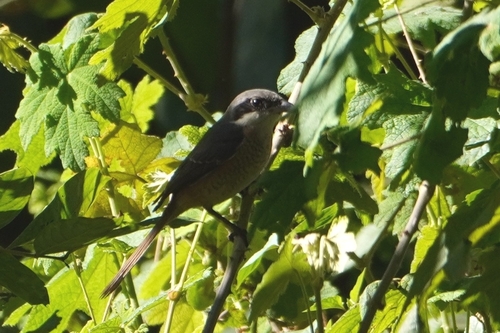 Grey-backed ShrikeLanius tephronotusThe species is 21–25 cm long and weighs 39-54 g.
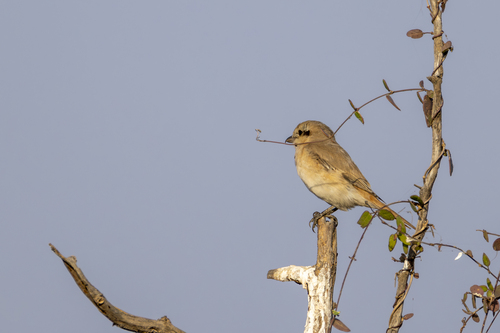 Isabelline ShrikeLanius isabellinusThe plumage is isabelline, the sandy colour which gives rise to its name.
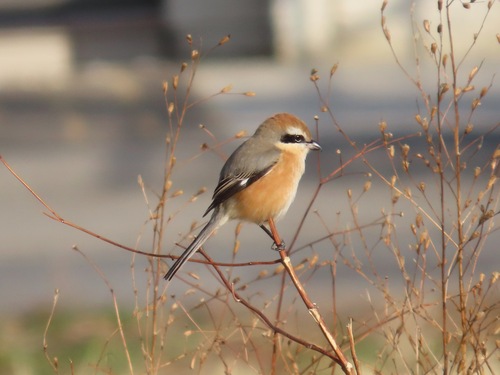 Bull-headed ShrikeLanius bucephalusThe bull-headed shrike is a passerine bird of eastern Asia belonging to the shrike family Laniidae.
Side by side: Isabelline Shrike vs Masked Shrike · Grey-backed Shrike vs Masked Shrike · Masked Shrike vs Northern Fiscal
Learn the Masked Shrike in the BeakBrain App
Photo and call practice. Coming soon to iPhone and Android.
Play today's Daily BirdEvery photo and recording on this page is credited to its author under the licence shown. Spotted a problem with this page, or have a better photo? Contribute.