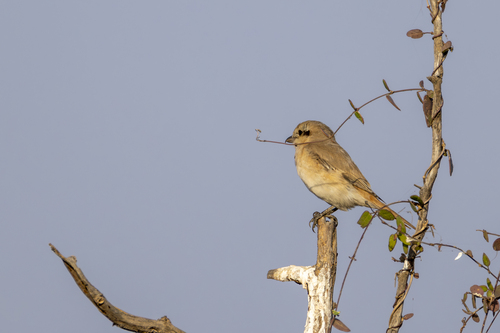
Isabelline Shrike
Lanius isabellinus
The plumage is isabelline, the sandy colour which gives rise to its name. It has a red tail. Young birds can be distinguished from young red-backed shrikes by the much sparser vermiculations on the underparts.
ID text from Wikipedia, CC BY-SA 4.0

Masked Shrike
Lanius nubicus
The masked shrike is the smallest of its genus, a slender bird which usually weighs 20–23 g (0.71–0.81 oz), measuring 17–18.5 cm (6.7–7.3 in) long with a 24–26.5 cm (9.4–10.4 in) wingspan. It has a long tail and relatively small bill, on each side of which is a tomial tooth; the upper mandible bears a triangular ridge which fits a corresponding notch in the lower mandible. This adaptation is otherwise only found in falcons. The male has mainly black upperparts, a white crown, forehead and supercilium. Voice: The masked shrike gives the harsh calls typical of this family, with repeated tsr, tzr or shek notes and some whistles, and when alarmed produces a rattling krrrr. The bill may be snapped when the bird is agitated. The song, up to a minute long, is soft for a shrike, with chattering sounds interspersed with rich warbles.
ID text from Wikipedia, CC BY-SA 4.0
Where you might meet both
Learn this pair in the BeakBrain App
Photo and call practice. Coming soon to iPhone and Android.
Play today's Daily BirdPhotos and recordings are credited to their authors under the licence shown. Full profiles: Isabelline Shrike and Masked Shrike.