Learn what every symbol on the card means.Full credits and sources at beakbrain.com/symbols
 WetlandCavity nestLarge · 843 g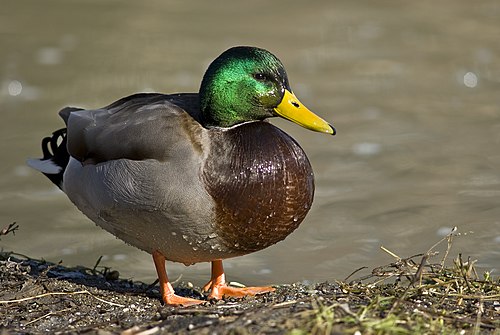

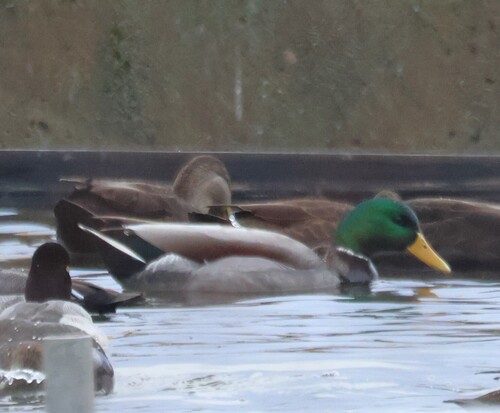
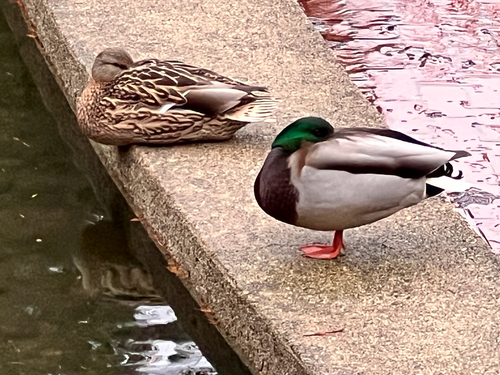
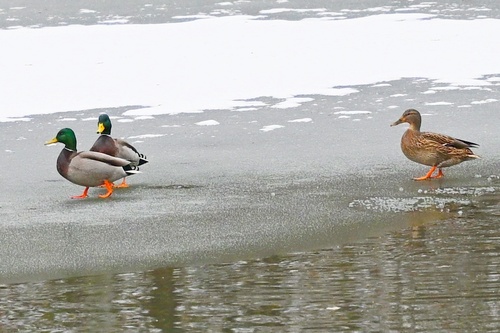
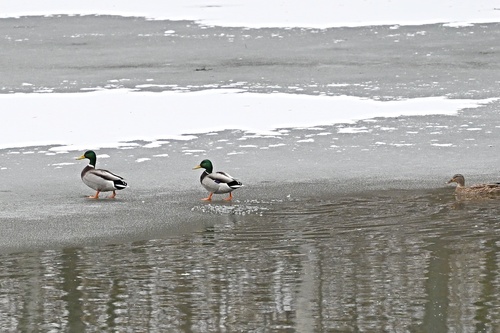
What the Mallard sounds like


ID tip
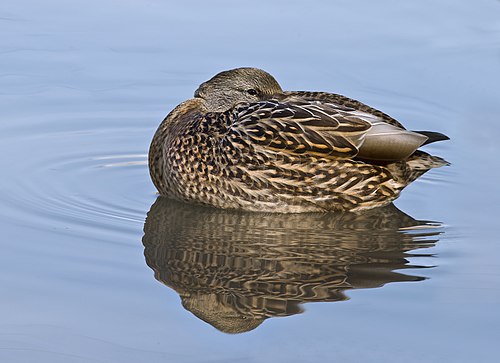
The mallard is a medium-sized waterfowl species that is often slightly heavier than most other dabbling ducks. It is 50–65 cm (20–26 in) long – of which the body makes up around two-thirds – has a wingspan of 81–98 cm (32–39 in), and weighs 0.7–1.6 kg (1.5–3.5 lb). Among standard measurements, the wing chord is 25.7 to 30.6 cm (10.1 to 12.0 in), the bill is 4.4 to 6.1 cm (1.7 to 2.4 in), and the tarsus is 4.1 to 4.8 cm (1.6 to 1.9 in). Voice: A noisy species, the female has the deep quack stereotypically associated with ducks. The female will often call with a sequence of 2–10 quacks in a row, starting loud and with the volume gradually decreasing. Male mallards make a sound phonetically similar to that of the female, a typical quack, but it is deeper and quieter compared to that of the female.
Text from Wikipedia, licensed CC BY-SA 4.0.
When to see the Mallard
One bar for each month, and every month is filled: this bird is recorded here in all twelve. The wide bar is May, the month with the most records.
Where to see the Mallard
The map shades 146 countries with regular records, and 10 more in a lighter tone where the bird turns up only as a stray. Everything unshaded has no records. Countries are listed below the map.
Recorded as a rare visitor in Mauritania, Kenya, Caribbean Netherlands, Jamaica, Martinique, Gibraltar, Guam, Paraguay, San Marino, New Caledonia.
About the Mallard
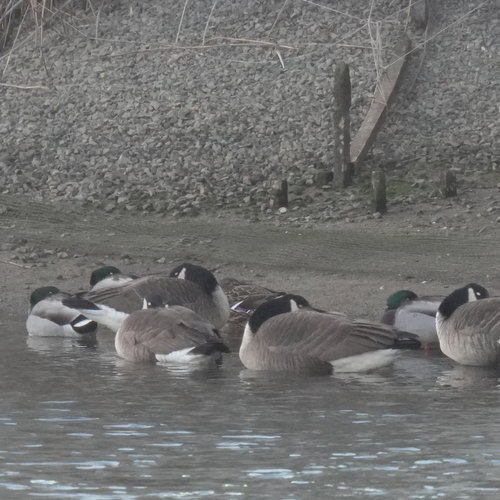
The mallard or wild duck is a dabbling duck that breeds throughout the temperate and subtropical Americas, Eurasia, and North Africa. It has been introduced to New Zealand, Australia, Peru, Brazil, Uruguay, Argentina, Chile, Colombia, the Falkland Islands, and South Africa. Belonging to the subfamily Anatinae of the waterfowl family Anatidae, mallards live in wetlands, eat water plants and small animals, and are social animals preferring to congregate in groups or flocks of varying sizes.
Text adapted from Wikipedia, licensed CC BY-SA 4.0.
Easily confused with
 Green-winged TealAnas creccaThe Eurasian teal is one of the smallest extant dabbling ducks at 34–43 cm (13–17 in) length and with an average weight of 360 g (13 oz) in drake (males) and 340 g (12 oz) in hens (females).
 Northern PintailAnas acutaThe northern pintail is a fairly large duck with a wing chord of 23.6–28.2 cm (9.3–11.1 in) and wingspan of 80–95 cm (31–37 in).
 American Black DuckAnas rubripesThe American black duck weighs 720–1,640 g (1.59–3.62 lb) and measures 54–59 cm (21–23 in) in length with a 88–95 cm (35–37 in) wingspan.
Side by side: Green-winged Teal vs Mallard · Mallard vs Northern Pintail · American Black Duck vs Mallard
Learn the Mallard in the BeakBrain App
Photo and call practice. Coming soon to iPhone and Android.
Play today's Daily BirdEvery photo and recording on this page is credited to its author under the licence shown. Spotted a problem with this page, or have a better photo? Contribute.