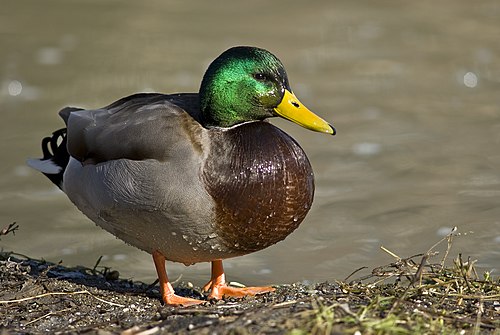
Mallard
Anas platyrhynchos
The mallard is a medium-sized waterfowl species that is often slightly heavier than most other dabbling ducks. It is 50–65 cm (20–26 in) long – of which the body makes up around two-thirds – has a wingspan of 81–98 cm (32–39 in), and weighs 0.7–1.6 kg (1.5–3.5 lb). Among standard measurements, the wing chord is 25.7 to 30.6 cm (10.1 to 12.0 in), the bill is 4.4 to 6.1 cm (1.7 to 2.4 in), and the tarsus is 4.1 to 4.8 cm (1.6 to 1.9 in). Voice: A noisy species, the female has the deep quack stereotypically associated with ducks. The female will often call with a sequence of 2–10 quacks in a row, starting loud and with the volume gradually decreasing. Male mallards make a sound phonetically similar to that of the female, a typical quack, but it is deeper and quieter compared to that of the female.
ID text from Wikipedia, CC BY-SA 4.0


Northern Pintail
Anas acuta
The northern pintail is a fairly large duck with a wing chord of 23.6–28.2 cm (9.3–11.1 in) and wingspan of 80–95 cm (31–37 in). The male is 59–76 cm (23–30 in) in length and weighs 450–1,360 g (0.99–3.00 lb), and therefore is considerably larger than the female, which is 51–64 cm (20–25 in) long and weighs 454–1,135 g (1.001–2.502 lb). The northern pintail broadly overlaps in size with the similarly widespread mallard, but is more slender, elongated and gracile, with a relatively longer neck and (in males) a longer tail.
ID text from Wikipedia, CC BY-SA 4.0

Where you might meet both
And 96 more countries.
Learn this pair in the BeakBrain App
Photo and call practice. Coming soon to iPhone and Android.
Play today's Daily BirdPhotos and recordings are credited to their authors under the licence shown. Full profiles: Mallard and Northern Pintail.