Learn what every symbol on the card means.Full credits and sources at beakbrain.com/symbols
 ForestCavity nestMedium · 297 g


What the Long-eared Owl sounds like


ID tip
This species is a slim and long winged owl with erectile ear tufts, which are positioned closer to the center of the head than in many other types of owl. The purposes of ear tufts are not definitively known and are present in about half of living owls. A theory amongst biologists and ornithologists is that ear tufts could be a means of intraspecies communication of intent and mood. In general coloration, the long-eared owl is a hue of ochraceous-tawny with a grayish or brownish wash variably manifesting.
Text from Wikipedia, licensed CC BY-SA 4.0.
When to see the Long-eared Owl
One bar for each month. Filled bars are the 10 months with records; pale bars are months with none. The wide bar is June, the month with the most records.
Where to see the Long-eared Owl
The map shades 70 countries with regular records, and 6 more in a lighter tone where the bird turns up only as a stray. Everything unshaded has no records. Countries are listed below the map.
Recorded as a rare visitor in United States, Taiwan, Guernsey, Georgia, Oman, Saudi Arabia.
About the Long-eared Owl
The long-eared owl, also known as the northern long-eared owl or, more informally, as the lesser horned owl or cat owl, is a medium-sized species of owl with an extensive breeding range. The genus name, Asio, is Latin for "horned owl", and the specific epithet, otus, is derived from Greek and refers to a small eared owl. The species breeds in many areas through Europe and the Palearctic, as well as in North America. This species is a part of the larger grouping of owls known as typical owls, of the family Strigidae, which contains most extant species of owl.
Text adapted from Wikipedia, licensed CC BY-SA 4.0.
Easily confused with
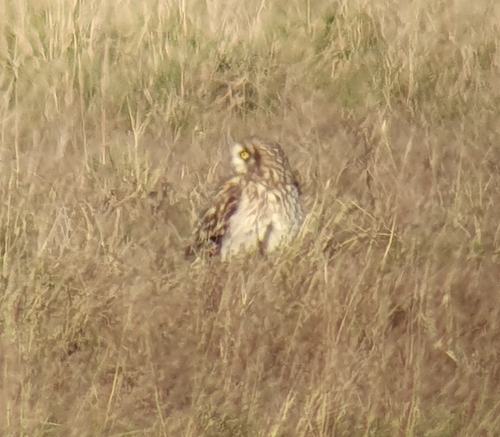 Short-eared OwlAsio flammeusThe short-eared owl is a medium-sized owl measuring 34–43 cm (13–17 in) in length and weighing 206–475 g (7.3–16.8 oz).
 Striped OwlAsio clamatorThe striped owl is a relatively large species with prominent tufts of elongated feathers on the crown resembling ears.
 Stygian OwlAsio stygiusThe Stygian owl is 38 to 46 cm (15 to 18 in) long and weighs about 400 to 675 g (14 to 24 oz).
Side by side: Long-eared Owl vs Short-eared Owl · Long-eared Owl vs Striped Owl · Long-eared Owl vs Stygian Owl
Watch the Long-eared Owl on live cams
 LIVE
LIVEBrowse all 118 bird cams worldwide, live and seasonal, by region and species.
Learn the Long-eared Owl in the BeakBrain App
Photo and call practice. Coming soon to iPhone and Android.
Play today's Daily BirdEvery photo and recording on this page is credited to its author under the licence shown. Spotted a problem with this page, or have a better photo? Contribute.