
Long-eared Owl
Asio otus
This species is a slim and long winged owl with erectile ear tufts, which are positioned closer to the center of the head than in many other types of owl. The purposes of ear tufts are not definitively known and are present in about half of living owls. A theory amongst biologists and ornithologists is that ear tufts could be a means of intraspecies communication of intent and mood. In general coloration, the long-eared owl is a hue of ochraceous-tawny with a grayish or brownish wash variably manifesting.
ID text from Wikipedia, CC BY-SA 4.0

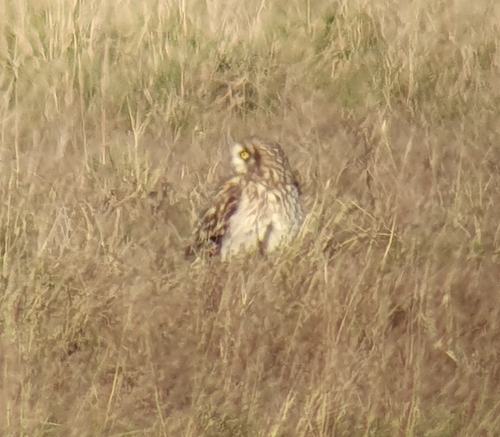
Short-eared Owl
Asio flammeus
The short-eared owl is a medium-sized owl measuring 34–43 cm (13–17 in) in length and weighing 206–475 g (7.3–16.8 oz). It has large eyes, a big head, a short neck, and broad wings. Its bill is short, strong, hooked and black. Its plumage is mottled tawny to brown with a barred tail and wings. The upper breast is significantly streaked. Its flight is characteristically floppy due to its irregular wingbeats. The short-eared owl may also be described as "moth or bat-like" in flight. Wingspans range from 85 to 110 cm (33 to 43 in). Females are slightly larger than males. Voice: Short-eared owls have a scratchy bark-like call. Raspy waowk, waowk, waowk or toot-toot-toot-toot-toot sounds are common. A loud eeee-yerp is also heard on breeding grounds. However, short-eared owls are silent on the wintering grounds.
ID text from Wikipedia, CC BY-SA 4.0

Where you might meet both
And 35 more countries.
Learn this pair in the BeakBrain App
Photo and call practice. Coming soon to iPhone and Android.
Play today's Daily BirdPhotos and recordings are credited to their authors under the licence shown. Full profiles: Long-eared Owl and Short-eared Owl.