Learn what every symbol on the card means.Full credits and sources at beakbrain.com/symbols
 ForestCavity nestLarge · 565 g

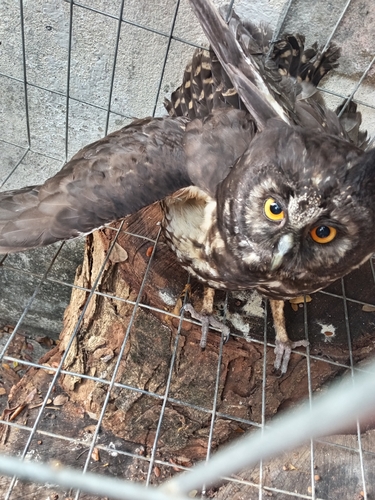
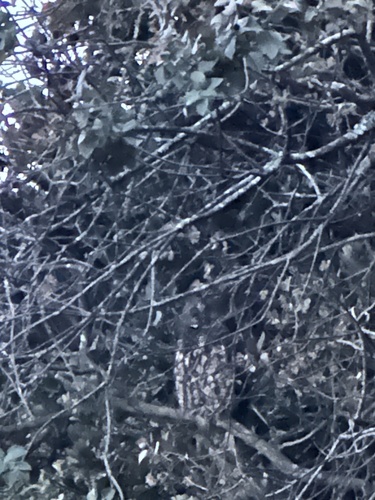
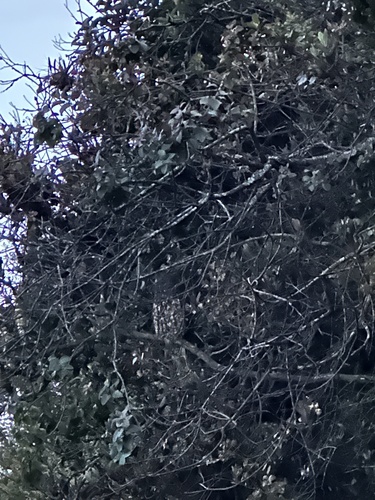
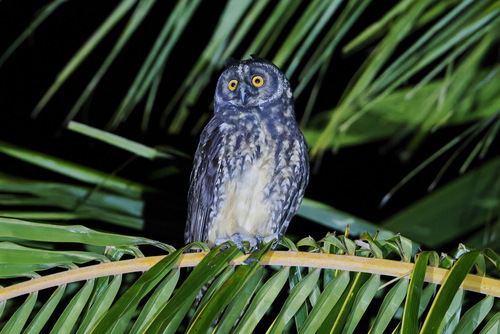
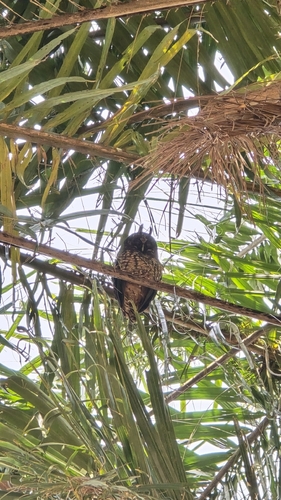
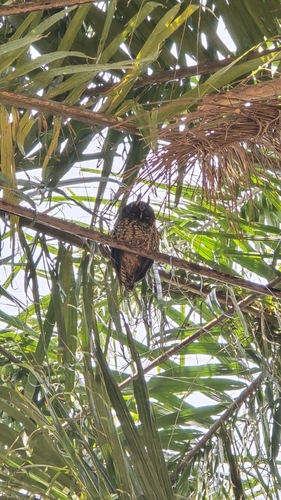
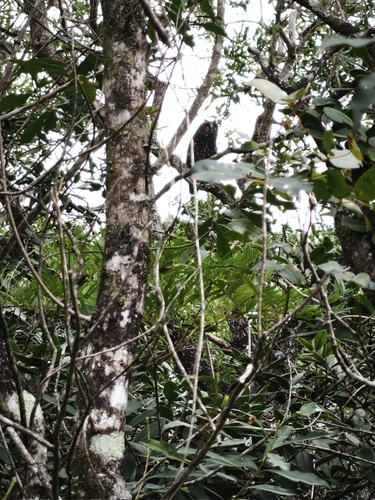
ID tip
The Stygian owl is 38 to 46 cm (15 to 18 in) long and weighs about 400 to 675 g (14 to 24 oz). The sexes have similar very dark plumage. (The adjective "Stygian" means "of, or relating to, the River Styx", but is more widely applied to anything that is dark or dismal.) The face is blackish with a pale border and a whitish forehead, and the head has long dark feathers that project upward as "ears". The dark upperparts have buff streaks and bars; the underparts are a dingy buff with dark brown or blackish barring and streaks. Voice: The Stygian owl's song has been variously described as "a single deep, emphatic woof or wupf", "a very low and loud hu or hu-hu", and "a muffled hoot given singly: boo". Females also give "a short, screamed rre-ehhr or mehrr" when calling to the male, and also "a short catlike miah".
Text from Wikipedia, licensed CC BY-SA 4.0.
When to see the Stygian Owl
One bar for each month, and every month is filled: this bird is recorded here in all twelve. The wide bar is February, the month with the most records.
Where to see the Stygian Owl
The map shades 15 countries with regular records, and 3 more in a lighter tone where the bird turns up only as a stray. Everything unshaded has no records. Countries are listed below the map.
Recorded as a rare visitor in United States, French Guiana, Paraguay.
About the Stygian Owl
The Stygian owl is a medium-sized "typical owl" in subfamily Striginae. It is found in Mexico, parts of Central America, Cuba, Hispaniola, and 10 countries in South America.
Text adapted from Wikipedia, licensed CC BY-SA 4.0.
Easily confused with
 Marsh OwlAsio capensisMedium-sized, dark brown with a pumpkin-shaped head with small 'ear' tufts.
 Striped OwlAsio clamatorThe striped owl is a relatively large species with prominent tufts of elongated feathers on the crown resembling ears.
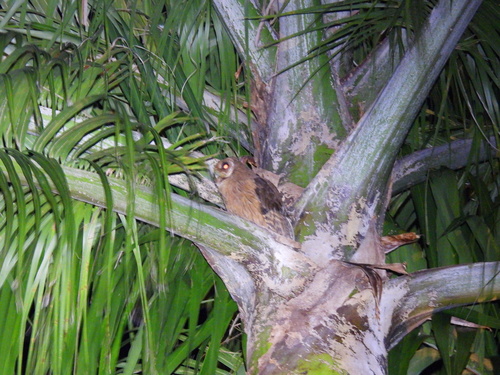 Jamaican OwlAsio grammicusThe Jamaican owl is 27 to 33 cm (11 to 13 in) long; one specimen of unstated sex weighed 335 g (11.8 oz).
Side by side: Short-eared Owl vs Stygian Owl · Long-eared Owl vs Stygian Owl · Striped Owl vs Stygian Owl · Marsh Owl vs Stygian Owl
Learn the Stygian Owl in the BeakBrain App
Photo and call practice. Coming soon to iPhone and Android.
Play today's Daily BirdEvery photo and recording on this page is credited to its author under the licence shown. Spotted a problem with this page, or have a better photo? Contribute.