Learn what every symbol on the card means.Full credits and sources at beakbrain.com/symbols
 GrasslandScrapeSmall · 21 g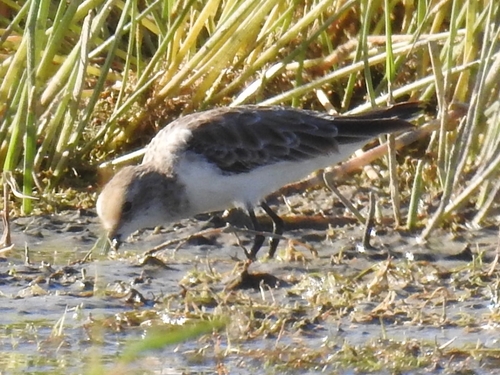


What the Little Stint sounds like

ID tip
Its small size, fine dark bill, dark legs and quicker movements distinguish this species from all waders except the other dark-legged stints. It can be distinguished from these in all plumages by its combination of a fine bill tip, unwebbed toes and long primary projection. The call is a sharp "stit". The breeding adult has an orange wash to the breast, a white throat and a strong white V on its back. In winter plumage identification is difficult. Juveniles have pale crown stripes and a pinkish breast.
Text from Wikipedia, licensed CC BY-SA 4.0.
When to see the Little Stint
One bar for each month. Filled bars are the 11 months with records; pale bars are months with none. The wide bar is September, the month with the most records.
Where to see the Little Stint
The map shades 139 countries with regular records, and 11 more in a lighter tone where the bird turns up only as a stray. Everything unshaded has no records. Countries are listed below the map.
Recorded as a rare visitor in United States, Canada, Panama, Mexico, Luxembourg, Liberia, Mauritius, South Sudan, Barbados, Guernsey, Northern Mariana Islands.
About the Little Stint
The little stint is a very small wader. It breeds in arctic Europe and Asia, and is a long-distance migrant, wintering south to Africa and south Asia. It occasionally is a vagrant to North America and to Australia. The genus name is from Ancient Greek kalidris or skalidris, a term used by Aristotle for some grey-coloured waterside birds. The specific minuta is Latin for "small.
Text adapted from Wikipedia, licensed CC BY-SA 4.0.
Easily confused with
 Curlew SandpiperCalidris ferrugineaThe curlew sandpiper is a small wader 18–23 cm in length and weighing 44–117 g.
 Red KnotCalidris canutusThe red knot or just knot is a medium-sized shorebird which breeds in tundra and the Arctic Cordillera in the far north of Canada, Europe, and Russia.
 Stilt SandpiperCalidris himantopusThe stilt sandpiper resembles the curlew sandpiper in its long bill, long neck, pale supercilium and white rump.
Side by side: Curlew Sandpiper vs Little Stint · Little Stint vs Stilt Sandpiper
Learn the Little Stint in the BeakBrain App
Photo and call practice. Coming soon to iPhone and Android.
Play today's Daily BirdEvery photo and recording on this page is credited to its author under the licence shown. Spotted a problem with this page, or have a better photo? Contribute.