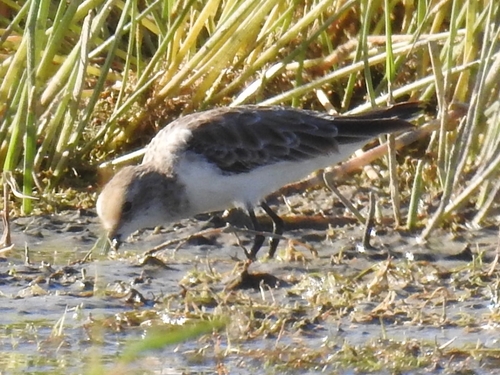
Little Stint
Calidris minuta
Its small size, fine dark bill, dark legs and quicker movements distinguish this species from all waders except the other dark-legged stints. It can be distinguished from these in all plumages by its combination of a fine bill tip, unwebbed toes and long primary projection. The call is a sharp "stit". The breeding adult has an orange wash to the breast, a white throat and a strong white V on its back. In winter plumage identification is difficult. Juveniles have pale crown stripes and a pinkish breast.
ID text from Wikipedia, CC BY-SA 4.0


Stilt Sandpiper
Calidris himantopus
The stilt sandpiper resembles the curlew sandpiper in its long bill, long neck, pale supercilium and white rump. It is readily distinguished from that species by its straighter bill (only slightly curved, not obviously so), its longer and greenish-yellow (not black) legs, and in flight, by the lack of a wingbar. It also lacks an obvious wing bar in flight. Breeding adults are distinctive, heavily barred with blackish bars on a white background beneath, and with reddish-orange patches above and below the white supercilium. The back is brown with darker feather centres.
ID text from Wikipedia, CC BY-SA 4.0
Where you might meet both
Learn this pair in the BeakBrain App
Photo and call practice. Coming soon to iPhone and Android.
Play today's Daily BirdPhotos and recordings are credited to their authors under the licence shown. Full profiles: Little Stint and Stilt Sandpiper.