Learn what every symbol on the card means.Full credits and sources at beakbrain.com/symbols
 CoastalScrapeSmall · 58 g



What the Curlew Sandpiper sounds like

ID tip
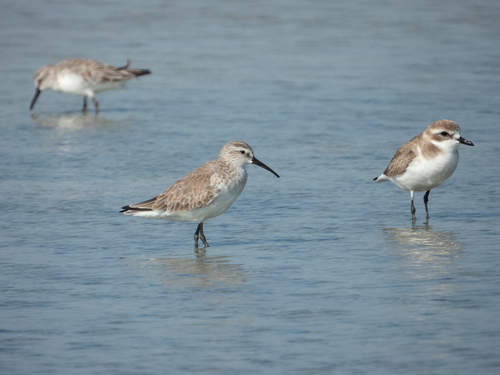
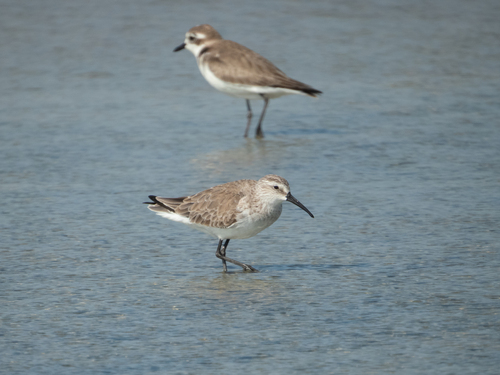
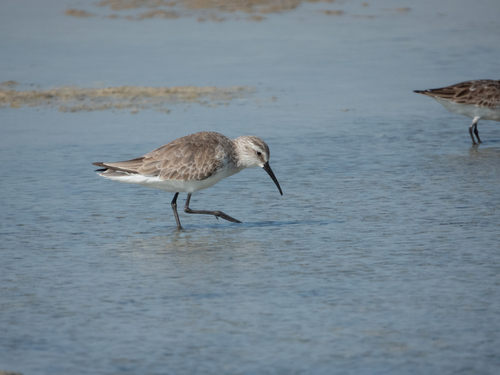
The curlew sandpiper is a small wader 18–23 cm in length and weighing 44–117 g. It has a wingspan of 38–46 cm, a bill length of 32–44 mm, and a tarsus (the bone between the "knee" and the "ankle") length of 26–34 mm. It has a black bill, dark brown irises, and dark grey to black feet. All plumages have a large white patch on the rump, occasionally barred with red in some adults, and in flight show a distinctive white stripe going across the wing. Like most waders, the curlew sandpiper has seasonal plumages and moults yearly, shedding its old feathers and growing new ones. Voice: Only the male sings. Each song lasts for 10–15 seconds and consists of several parts, starting with several introductory notes, followed by multiple trilled doublets, a four-part phrase, and several drawn-out whine calls. Both genders vocalise calls. The alarm call is a whik, whik, whik repeated or wik-ki-ki-ki...
Text from Wikipedia, licensed CC BY-SA 4.0.
When to see the Curlew Sandpiper
One bar for each month. Filled bars are the 9 months with records; pale bars are months with none. The wide bar is August, the month with the most records.
Where to see the Curlew Sandpiper
The map shades 142 countries with regular records, and 18 more in a lighter tone where the bird turns up only as a stray. Everything unshaded has no records. Countries are listed below the map.
Recorded as a rare visitor in Chile, Luxembourg, Brazil, Chad, Mali, Togo, French Guiana, Martinique, Brunei, Benin, Costa Rica, St. Pierre & Miquelon, Trinidad & Tobago, Syria, Guernsey, Guam, Solomon Islands, Vanuatu.
About the Curlew Sandpiper
The curlew sandpiper is a small wader. It is a long-distance migrant, breeding in the bogs and coastal lowlands of the Siberian Arctic, arriving there in June and staying until August or September. After the breeding season, it migrates south to spend the winter in Africa and along the coasts of Oceania and southern Eurasia, occupying tidal mudflats and saltpans.
Text adapted from Wikipedia, licensed CC BY-SA 4.0.
Easily confused with
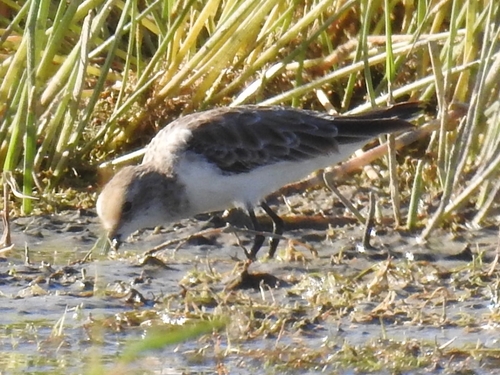 Little StintCalidris minutaIts small size, fine dark bill, dark legs and quicker movements distinguish this species from all waders except the other dark-legged stints.
 Stilt SandpiperCalidris himantopusThe stilt sandpiper resembles the curlew sandpiper in its long bill, long neck, pale supercilium and white rump.
 Baird's SandpiperCalidris bairdiiAdults have black legs and a short, straight, thin dark bill.
Side by side: Curlew Sandpiper vs Little Stint · Curlew Sandpiper vs Stilt Sandpiper · Baird's Sandpiper vs Curlew Sandpiper
Learn the Curlew Sandpiper in the BeakBrain App
Photo and call practice. Coming soon to iPhone and Android.
Play today's Daily BirdEvery photo and recording on this page is credited to its author under the licence shown. Spotted a problem with this page, or have a better photo? Contribute.