Learn what every symbol on the card means.Full credits and sources at beakbrain.com/symbols
 GrasslandScrapeLarge · 833 g


What the Little Bustard sounds like


ID tip
Although the smallest Palearctic bustard, the little bustard is still pheasant-sized at 42–45 cm (17–18 in) long with a 90–110 cm (35–43 in) wingspan and a weight of 830 g (29 oz). In flight, the long wings are extensively white. The breeding male is brown above and white below, with a grey head and a black neck bordered above and below by white. The female and non-breeding male lack the dramatic neck pattern, and the female is marked darker below than the male. Immature bustards resemble females.
Text from Wikipedia, licensed CC BY-SA 4.0.
When to see the Little Bustard
One bar for each month. Filled bars are the 7 months with records; pale bars are months with none. The wide bar is May, the month with the most records.
Where to see the Little Bustard
The map shades 23 countries with regular records, and 13 more in a lighter tone where the bird turns up only as a stray. Everything unshaded has no records. Countries are listed below the map.
Recorded as a rare visitor in Belgium, United Kingdom, Norway, Netherlands, Germany, Morocco, Finland, Czechia, India, Poland, Austria, Algeria, Cyprus.
About the Little Bustard
The little bustard is a bird in the bustard family, the only member of the genus Tetrax. It breeds in Southern Europe and in Western and Central Asia.
Text adapted from Wikipedia, licensed CC BY-SA 4.0.
Easily confused with
 Northern Black KorhaanAfrotis afraoidesThe male's plumage has regularly-arranged black and white barring on the back and wings, the head, neck and underparts being black.
 Red-crested KorhaanLophotis ruficristaThe red-crested korhaan grows up to 50 cm (1.6 ft) in length with a maximal weight of 680 g (1.5 lb).
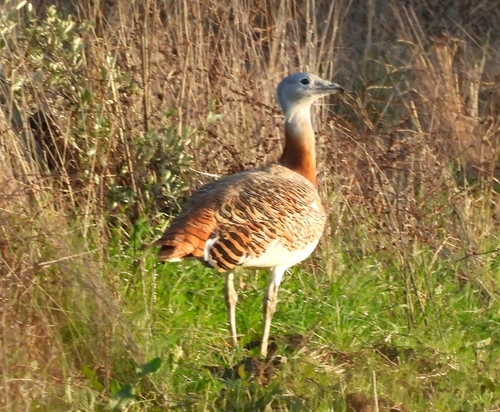 Great BustardOtis tardaThe adult male great bustard is amongst the heaviest living flying birds.
Side by side: Little Bustard vs Northern Black Korhaan · Little Bustard vs Red-crested Korhaan · Great Bustard vs Little Bustard
Learn the Little Bustard in the BeakBrain App
Photo and call practice. Coming soon to iPhone and Android.
Play today's Daily BirdEvery photo and recording on this page is credited to its author under the licence shown. Spotted a problem with this page, or have a better photo? Contribute.