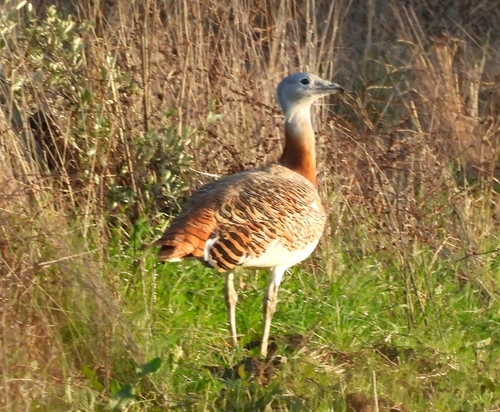
Great Bustard
Otis tarda
The adult male great bustard is amongst the heaviest living flying birds. A male is typically 90–105 cm (2 ft 11 in – 3 ft 5 in) tall, with a length of around 115 cm (3 ft 9 in) and has a 2.1–2.7 m (6 ft 11 in – 8 ft 10 in) wingspan. The male can range in weight from 5.8 to 18 kg (13 to 40 lb). The heaviest verified specimen, collected in Manchuria, was about 21 kg (46 lb), a world record for heaviest flying bird. In a study in Spain, one male weighed as much as 19 kg (42 lb). Larger specimens have been reported but remain unverified.
ID text from Wikipedia, CC BY-SA 4.0

Little Bustard
Tetrax tetrax
Although the smallest Palearctic bustard, the little bustard is still pheasant-sized at 42–45 cm (17–18 in) long with a 90–110 cm (35–43 in) wingspan and a weight of 830 g (29 oz). In flight, the long wings are extensively white. The breeding male is brown above and white below, with a grey head and a black neck bordered above and below by white. The female and non-breeding male lack the dramatic neck pattern, and the female is marked darker below than the male. Immature bustards resemble females.
ID text from Wikipedia, CC BY-SA 4.0

Where you might meet both
Learn this pair in the BeakBrain App
Photo and call practice. Coming soon to iPhone and Android.
Play today's Daily BirdPhotos and recordings are credited to their authors under the licence shown. Full profiles: Great Bustard and Little Bustard.