Learn what every symbol on the card means.Full credits and sources at beakbrain.com/symbols
 ShrublandCavity nestSmall · 29 g


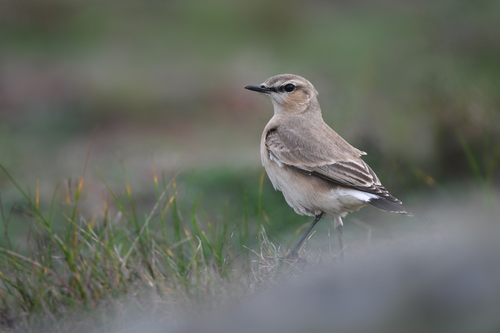
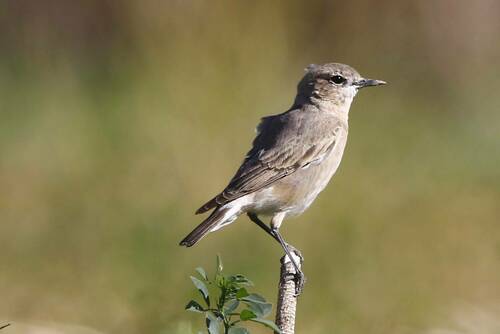
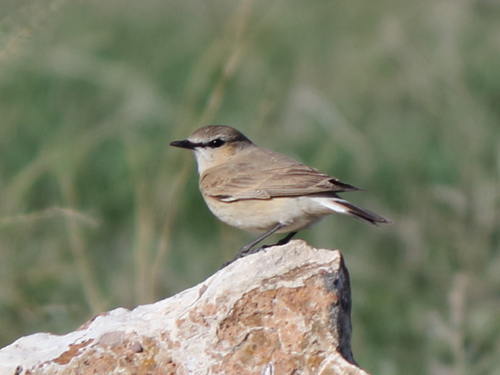
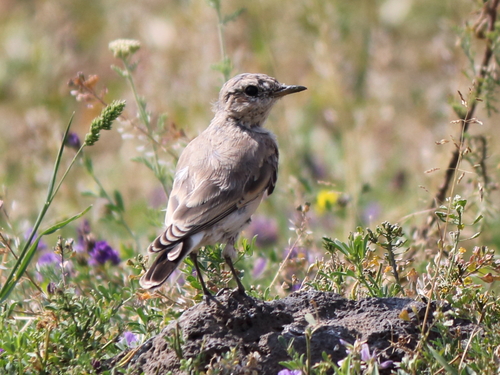
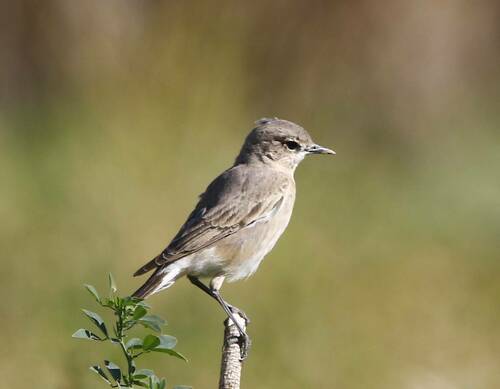
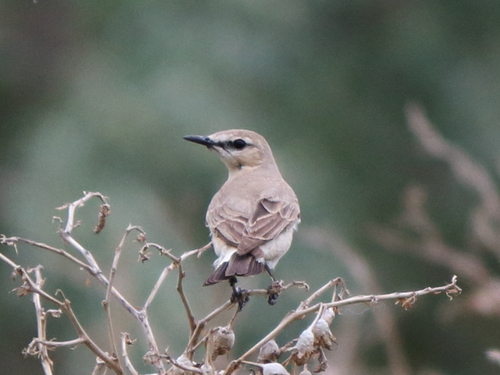
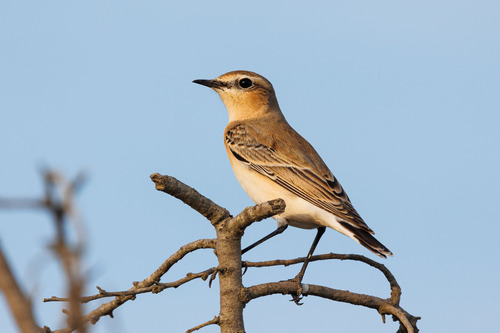
ID tip
Male and female isabelline wheatear are similar in appearance. The upper-parts are a pale sandy brown with an isabelline tinge (isabelline is a pale grey-yellow, fawn, cream-brown or parchment colour). The lower back is isabelline and the rump and upper tail-coverts are white. The tail feathers are brownish-black with a narrow edge and tip of buff and a large white base. In the outer tail feathers this occupies more than half the length of the feather but in the central feathers it is about one third. There is an over-eye streak of creamy white and the ear-coverts are pale brown.
Text from Wikipedia, licensed CC BY-SA 4.0.
When to see the Isabelline Wheatear
One bar for each month. Filled bars are the 11 months with records; pale bars are months with none. The wide bar is March, the month with the most records.
Where to see the Isabelline Wheatear
The map shades 70 countries with regular records, and 14 more in a lighter tone where the bird turns up only as a stray. Everything unshaded has no records. Countries are listed below the map.
Recorded as a rare visitor in Norway, France, Finland, Germany, Netherlands, Ireland, Australia, Rwanda, Portugal, Slovakia, Seychelles, Japan, South Korea, Thailand.
About the Isabelline Wheatear
The isabelline wheatear is a small passerine bird that was formerly classed as a member of the thrush family Turdidae, but is now more generally considered to be an Old World flycatcher in the family Muscicapidae. It is a migratory insectivorous bird. Its habitat is steppe and open countryside and it breeds in southern Russia and Central Asia to northern Pakistan, wintering in Africa and northwestern India. It is a very rare vagrant to western Europe.
Text adapted from Wikipedia, licensed CC BY-SA 4.0.
Easily confused with
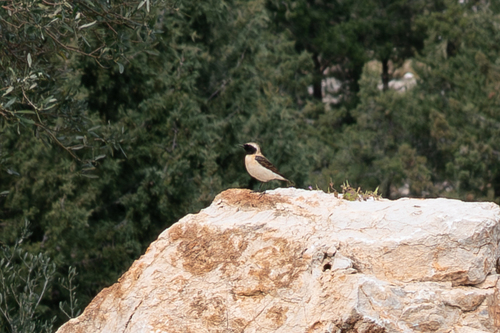 Western Black-eared WheatearOenanthe hispanicaThe breeding male has the forehead and crown white or nearly white, the mantle buff, and the wings blacker than those of the northern wheatear.
 Brown Rock ChatOenanthe fuscaThe brown rock chat is about 17 cm long, larger than the somewhat similar-looking Indian robin.
 Desert WheatearOenanthe desertiThe head and nape of the adult male desert wheatear are a pale sandy-grey colour with the feathers tipped grey.
Side by side: Isabelline Wheatear vs Northern Wheatear · Familiar Chat vs Isabelline Wheatear · Isabelline Wheatear vs Western Black-eared Wheatear · Brown Rock Chat vs Isabelline Wheatear · Desert Wheatear vs Isabelline Wheatear
Learn the Isabelline Wheatear in the BeakBrain App
Photo and call practice. Coming soon to iPhone and Android.
Play today's Daily BirdEvery photo and recording on this page is credited to its author under the licence shown. Spotted a problem with this page, or have a better photo? Contribute.