Learn what every symbol on the card means.Full credits and sources at beakbrain.com/symbols
 GrasslandPlatform nestHuge · 2.5 kg


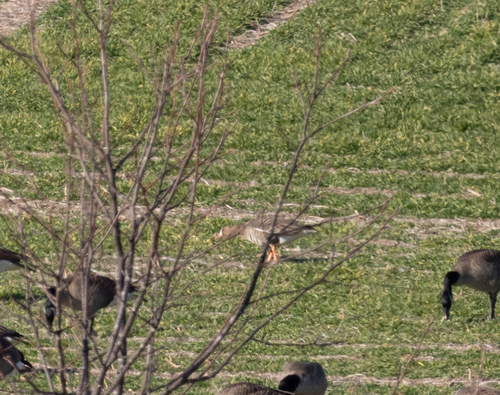
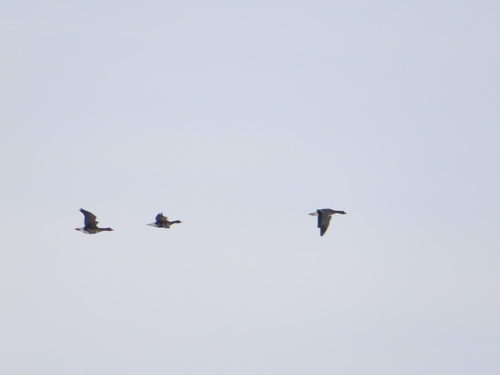
What the Greater White-fronted Goose sounds like


ID tip
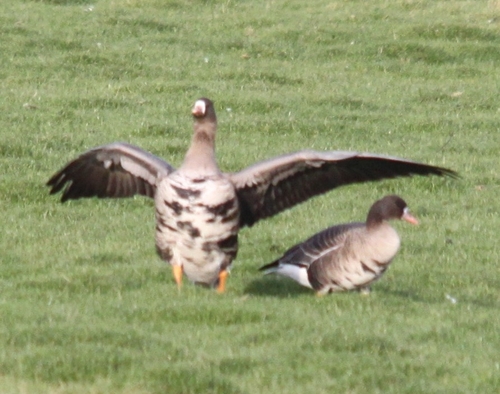
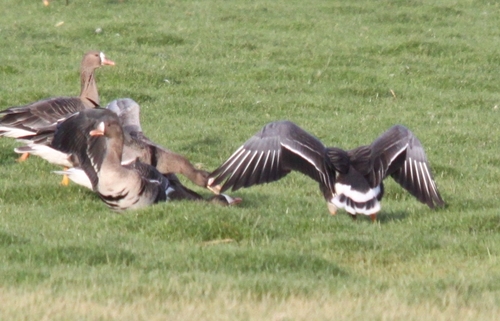
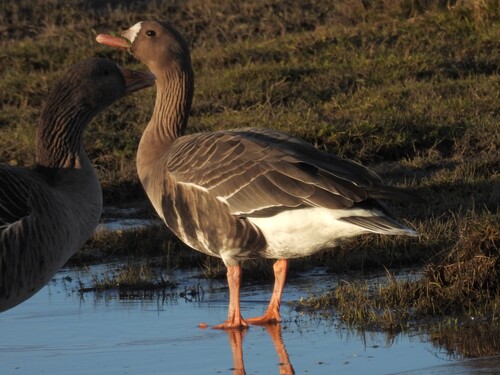
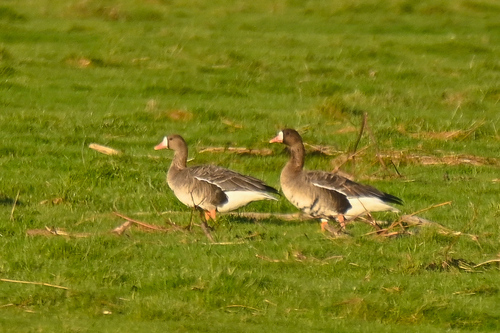
Greater white-fronted geese are 64–81 cm (25–32 in) in length, have a 130–165 cm (51–65 in) wingspan, and weigh 1.93–3.31 kg (4 lb 4 oz – 7 lb 5 oz). They have bright orange legs and mouse-coloured upper wing coverts. They are smaller than greylag geese. The greater white-fronted goose is larger than and lacks the yellow eye ring of the lesser white-fronted goose, and its white facial blaze does not extend upwards so far as in the lesser.
Text from Wikipedia, licensed CC BY-SA 4.0.
When to see the Greater White-fronted Goose
One bar for each month. Filled bars are the 9 months with records; pale bars are months with none. The wide bar is March, the month with the most records.
Where to see the Greater White-fronted Goose
The map shades 75 countries with regular records, and 7 more in a lighter tone where the bird turns up only as a stray. Everything unshaded has no records. Countries are listed below the map.
Recorded as a rare visitor in Morocco, Cuba, Myanmar (Burma), Egypt, Guadeloupe, St. Pierre & Miquelon, Kyrgyzstan.
About the Greater White-fronted Goose
The greater white-fronted goose is a species of goose, closely related to the smaller lesser white-fronted goose. The greater white-fronted goose is migratory, breeding in northern Canada, Alaska, Greenland, and Russia, and winters farther south in North America, Europe, and Asia. It is named for the patch of white feathers bordering the base of its bill; its specific name albifrons comes from the Latin albus "white" and frons "forehead". In the United Kingdom and Ireland, it has been known as the white-fronted goose; in North America, it is known as the greater white-fronted goose, and this name is also increasingly adopted internationally.
Text adapted from Wikipedia, licensed CC BY-SA 4.0.
Easily confused with
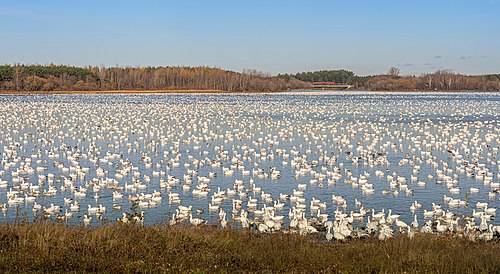 Snow GooseAnser caerulescensThe snow goose has two color plumage morphs, white (snow) or gray/blue (blue), thus the common description as "snows" and "blues".
 Pink-footed GooseAnser brachyrhynchusIt is a medium-sized goose, 60–75 cm (24–30 in) long, the wingspan 135–170 cm (53–67 in), and weighing 1.8–3.4 kg (4.0–7.5 lb).
 Ross's GooseAnser rossiiRoss's goose has a rounded head above a short neck.
Side by side: Greater White-fronted Goose vs Greylag Goose · Egyptian Goose vs Greater White-fronted Goose · Greater White-fronted Goose vs Snow Goose · Greater White-fronted Goose vs Pink-footed Goose · Greater White-fronted Goose vs Ross's Goose
Learn the Greater White-fronted Goose in the BeakBrain App
Photo and call practice. Coming soon to iPhone and Android.
Play today's Daily BirdEvery photo and recording on this page is credited to its author under the licence shown. Spotted a problem with this page, or have a better photo? Contribute.