Learn what every symbol on the card means.Full credits and sources at beakbrain.com/symbols
 WetlandPlatform nestHuge · 1.6 kg


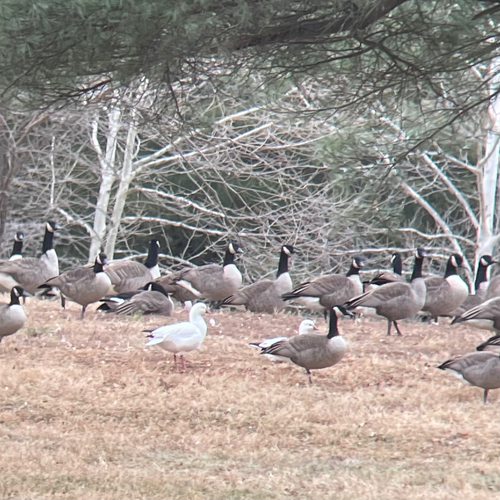
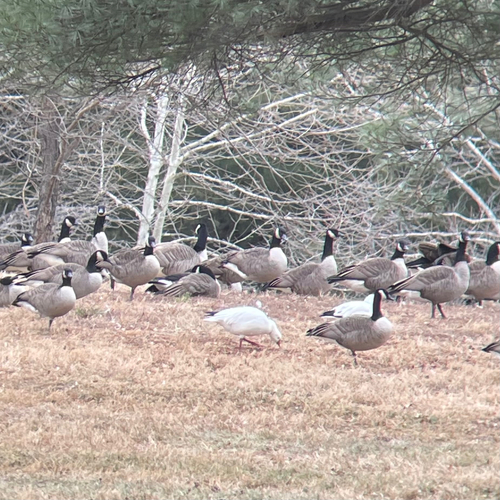
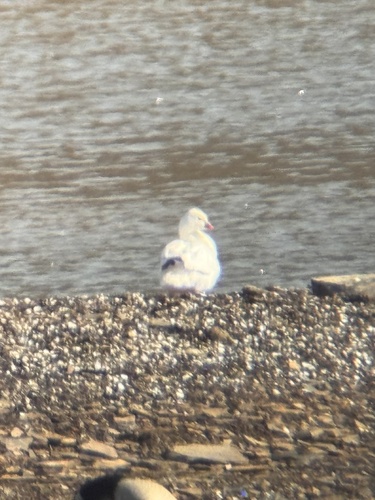

ID tip
Ross's goose has a rounded head above a short neck. The bill is short and triangular and has a bluish base with warty structures that increase in prominence with age. Adults are identified by all-white secondary feathers, while juveniles' are dark centered. Females average 6% smaller than males. Legs begin as olive gray on goslings and turn deep red as they mature.No geographic variation or identified subspecies is known. Related species include other Anser geese, particularly the lesser snow goose, where the two mtDNA lineages imply frequent hybridization.
Text from Wikipedia, licensed CC BY-SA 4.0.
When to see the Ross's Goose
One bar for each month. Filled bars are the 7 months with records; pale bars are months with none. The wide bar is January, the month with the most records.
Where to see the Ross's Goose
The map shades 11 countries with regular records, and 6 more in a lighter tone where the bird turns up only as a stray. Everything unshaded has no records. Countries are listed below the map.
Recorded as a rare visitor in Belgium, Finland, Poland, Denmark, France, Bahamas.
About the Ross's Goose
Ross's goose is a white goose with black wingtips and a relatively short neck. It is the smallest of the three white geese that breed in North America. It is similar in appearance to a white-phase snow goose, but about 40% smaller. Other differences from the snow goose are that the bill is smaller in proportion to its body and lacks "black lips". Like snow geese, Ross's geese may exhibit a darker "blue" phase or morph, though this is extremely rare.
Text adapted from Wikipedia, licensed CC BY-SA 4.0.
Easily confused with
 Tundra Bean GooseAnser serrirostrisThe length ranges from 68 to 90 cm (27–35 in), wingspan from 140 to 174 cm (55–69 in) and weight from 1.7–4 kg (3.7–8.8 lb).
 Taiga Bean GooseAnser fabalisThe length ranges from 68 to 90 cm (27–35 in), wingspan from 140 to 174 cm (55–69 in) and weight from 1.7–4 kg (3.7–8.8 lb).
 Bar-headed GooseAnser indicusThe bird is pale grey and is easily distinguished from any of the other grey geese of the genus Anser by the black bars on its otherwise white head.
Side by side: Ross's Goose vs Snow Goose · Greater White-fronted Goose vs Ross's Goose · Pink-footed Goose vs Ross's Goose · Ross's Goose vs Tundra Bean Goose · Ross's Goose vs Taiga Bean Goose · Bar-headed Goose vs Ross's Goose
Learn the Ross's Goose in the BeakBrain App
Photo and call practice. Coming soon to iPhone and Android.
Play today's Daily BirdEvery photo and recording on this page is credited to its author under the licence shown. Spotted a problem with this page, or have a better photo? Contribute.