
Ross's Goose
Anser rossii
Ross's goose has a rounded head above a short neck. The bill is short and triangular and has a bluish base with warty structures that increase in prominence with age. Adults are identified by all-white secondary feathers, while juveniles' are dark centered. Females average 6% smaller than males. Legs begin as olive gray on goslings and turn deep red as they mature.No geographic variation or identified subspecies is known. Related species include other Anser geese, particularly the lesser snow goose, where the two mtDNA lineages imply frequent hybridization.
ID text from Wikipedia, CC BY-SA 4.0
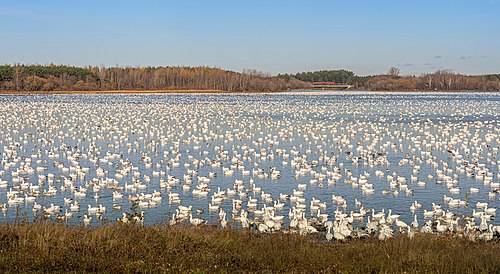
Snow Goose
Anser caerulescens
The snow goose has two color plumage morphs, white (snow) or gray/blue (blue), thus the common description as "snows" and "blues". White-morph birds are white except for black wing tips, but blue-morph geese have bluish-gray plumage replacing the white except on the head, neck, and tail tip. The immature blue phase is drab or slate-gray with little to no white on the head, neck, or belly. Both snow and blue phases have rose-red feet and legs and pink bills with black tomia ("cutting edges"), giving them a black "grin patch". These colors distinguish the species from white domesticated geese.
ID text from Wikipedia, CC BY-SA 4.0
Where you might meet both
Learn this pair in the BeakBrain App
Photo and call practice. Coming soon to iPhone and Android.
Play today's Daily BirdPhotos and recordings are credited to their authors under the licence shown. Full profiles: Ross's Goose and Snow Goose.