Learn what every symbol on the card means.Full credits and sources at beakbrain.com/symbols
 CoastalScrapeLarge · 328 g






What the Greater Crested Tern sounds like

ID tip
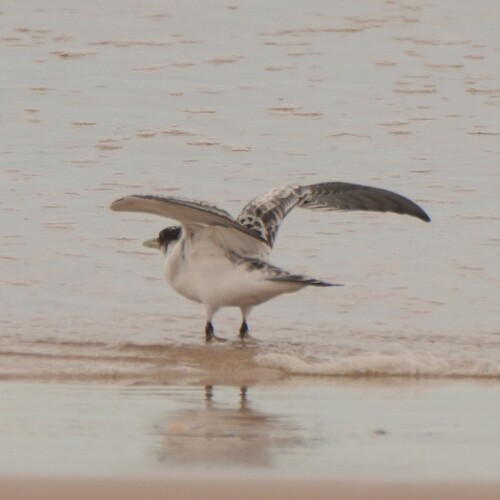
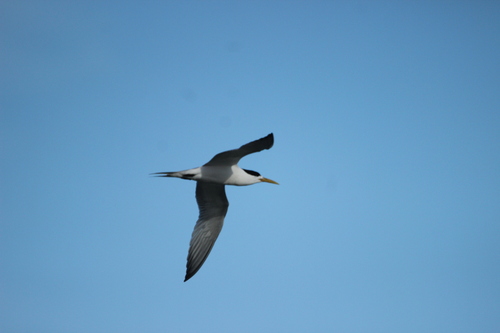
The greater crested tern is a large tern with a long (5.4–6.5 cm or 2.1–2.6 in) yellow bill, black legs, and a glossy black crest that is noticeably shaggy at its rear. The breeding adult of the nominate subspecies T. b. bergii is 46–49 cm (18–19.5 in) long, with a 125–130 cm (49–51 in) wing-span; weight 325–397 grams (11.5–14.0 oz). The forehead and the underparts are white, the back and inner wings are dusky-grey. In winter, the upperparts plumage wears to a paler grey, and the crown of the head becomes white, merging at the rear into a peppered black crest and mask.
Text from Wikipedia, licensed CC BY-SA 4.0.
When to see the Greater Crested Tern
One bar for each month, and every month is filled: this bird is recorded here in all twelve. The wide bar is January, the month with the most records.
Where to see the Greater Crested Tern
The map shades 63 countries with regular records, and 3 more in a lighter tone where the bird turns up only as a stray. Everything unshaded has no records. Countries are listed below the map.
Recorded as a rare visitor in United States, Northern Mariana Islands, Pitcairn Islands.
About the Greater Crested Tern
The greater crested tern, also called crested tern, swift tern, or great crested tern, is a tern in the family Laridae that nests in dense colonies on coastlines and islands in the tropical and subtropical Old World. Its four or five subspecies breed in the area from South Africa around the Indian Ocean to the central Pacific and Australia, all populations dispersing widely from the breeding range after nesting. This large tern is closely related to other species in its genus, but can be distinguished by its darker, battleship-grey upperparts, white forehead even in full breeding plumage, and greenish-tinged yellow bill colour.
Text adapted from Wikipedia, licensed CC BY-SA 4.0.
Easily confused with
 Elegant TernThalasseus elegansThis is a medium-large tern, with a long, slender, slightly downcurved orange bill, pale gray upperparts and white underparts.
 Lesser Crested TernThalasseus bengalensisThis is a medium-large tern, 35–43 cm long and with a 88–105 cm wingspan; its weight ranges from 185–242 g.
 West African Crested TernThalasseus albididorsalisThe West African crested tern is one of the three larger crested terns, along with royal tern and greater crested tern.
Side by side: Greater Crested Tern vs Royal Tern · Greater Crested Tern vs Sandwich Tern · Greater Crested Tern vs Little Gull · Elegant Tern vs Greater Crested Tern · Greater Crested Tern vs Lesser Crested Tern · Greater Crested Tern vs West African Crested Tern
Learn the Greater Crested Tern in the BeakBrain App
Photo and call practice. Coming soon to iPhone and Android.
Play today's Daily BirdEvery photo and recording on this page is credited to its author under the licence shown. Spotted a problem with this page, or have a better photo? Contribute.