Learn what every symbol on the card means.Full credits and sources at beakbrain.com/symbols
 ForestCup nestSmall · 18 g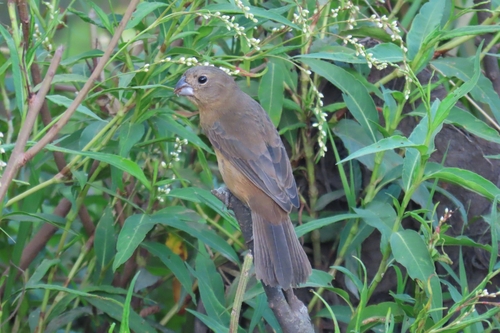


ID tip
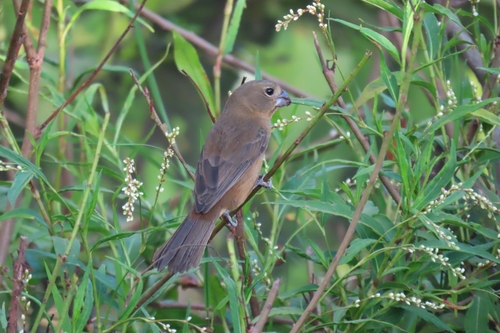
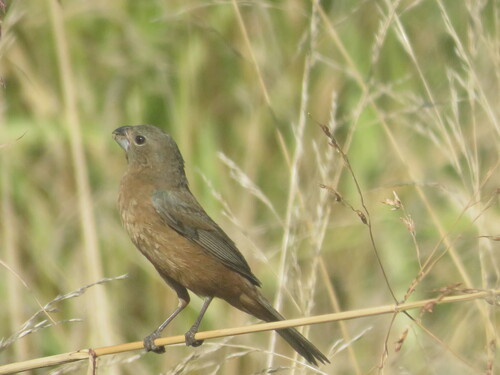
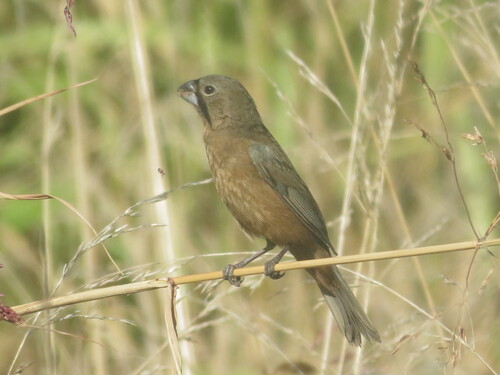
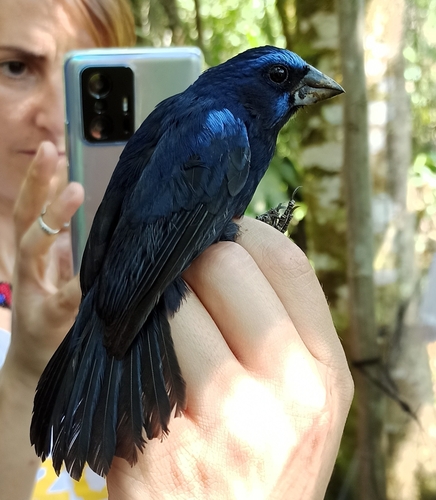
The glaucous-blue grosbeak is approximately 14 cm (5.5 in) long. Three birds weighed from 16 to 19.5 g (0.56 to 0.69 oz). The male is generally dark sky blue that is lighter on the forehead and rump and is grayish on the lower belly. It has a small black "mask". The female is brown overall, warm and dark above and orange-tinged below. The immature is orange-brown that is darker on the back, and it has a hint of blue on the forehead and cheek. Voice: The glaucous-blue grosbeak usually sings from dense cover, "a fast, high, hurried jumbled warbling" . Its call is "psit" or "jit" .
Text from Wikipedia, licensed CC BY-SA 4.0.
When to see the Glaucous-blue Grosbeak
One bar for each month. Filled bars are the 9 months with records; pale bars are months with none. The wide bar is November, the month with the most records.
Where to see the Glaucous-blue Grosbeak
The map shades 4 countries with regular records. Everything unshaded has no records. Countries are listed below the map.
About the Glaucous-blue Grosbeak
The glaucous-blue grosbeak, also known as the indigo grosbeak, is a species of bird in the family Cardinalidae, the cardinals or cardinal grosbeaks. It is found in Brazil, Argentina, Paraguay, and Uruguay.
Text adapted from Wikipedia, licensed CC BY-SA 4.0.
Easily confused with
 Amazonian GrosbeakCyanoloxia rothschildiiThe Amazonian grosbeak is 14.5 to 15 cm (5.7 to 5.9 in) long and weighs 21.5 to 31 g (0.76 to 1.09 oz).
 Ultramarine GrosbeakCyanoloxia brissoniiThese birds are 15 cm long.
 Blue-black GrosbeakCyanoloxia cyanoidesThe blue-black grosbeak is sexually dimorphic.
Side by side: Blue-black Grosbeak vs Glaucous-blue Grosbeak · Glaucous-blue Grosbeak vs Ultramarine Grosbeak · Amazonian Grosbeak vs Glaucous-blue Grosbeak
Learn the Glaucous-blue Grosbeak in the BeakBrain App
Photo and call practice. Coming soon to iPhone and Android.
Play today's Daily BirdEvery photo and recording on this page is credited to its author under the licence shown. Spotted a problem with this page, or have a better photo? Contribute.