
Blue-black Grosbeak
Cyanoloxia cyanoides
The blue-black grosbeak is sexually dimorphic. Females have dark brown plumage which can have a slight reddish hue. Males are dark blue with lighter blue eyebrows and shoulder patches on their wings. The forehead, the area just above the beak, is also a lighter shade of blue. Voice: Often blue-black grosbeaks will not be seen since they prefer to stay hidden among the vegetation, so most of the time their presence is known only when they vocalize. Their song is composed of about six whistles with decreasing pitch and ends with a "seee seee sewee suwee sweet suuu." There are slight differences in the songs between the three different subspecies.
ID text from Wikipedia, CC BY-SA 4.0

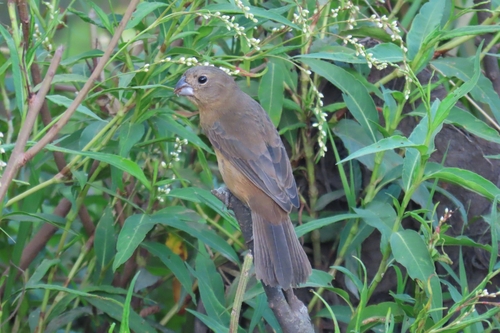
Glaucous-blue Grosbeak
Cyanoloxia glaucocaerulea
The glaucous-blue grosbeak is approximately 14 cm (5.5 in) long. Three birds weighed from 16 to 19.5 g (0.56 to 0.69 oz). The male is generally dark sky blue that is lighter on the forehead and rump and is grayish on the lower belly. It has a small black "mask". The female is brown overall, warm and dark above and orange-tinged below. The immature is orange-brown that is darker on the back, and it has a hint of blue on the forehead and cheek. Voice: The glaucous-blue grosbeak usually sings from dense cover, "a fast, high, hurried jumbled warbling" . Its call is "psit" or "jit" .
ID text from Wikipedia, CC BY-SA 4.0
Learn this pair in the BeakBrain App
Photo and call practice. Coming soon to iPhone and Android.
Play today's Daily BirdPhotos and recordings are credited to their authors under the licence shown. Full profiles: Blue-black Grosbeak and Glaucous-blue Grosbeak.