Learn what every symbol on the card means.Full credits and sources at beakbrain.com/symbols
 ForestCup nestSmall · 33 g


What the Blue-black Grosbeak sounds like


ID tip
The blue-black grosbeak is sexually dimorphic. Females have dark brown plumage which can have a slight reddish hue. Males are dark blue with lighter blue eyebrows and shoulder patches on their wings. The forehead, the area just above the beak, is also a lighter shade of blue. Voice: Often blue-black grosbeaks will not be seen since they prefer to stay hidden among the vegetation, so most of the time their presence is known only when they vocalize. Their song is composed of about six whistles with decreasing pitch and ends with a "seee seee sewee suwee sweet suuu." There are slight differences in the songs between the three different subspecies.
Text from Wikipedia, licensed CC BY-SA 4.0.
When to see the Blue-black Grosbeak
One bar for each month, and every month is filled: this bird is recorded here in all twelve. The wide bar is March, the month with the most records.
Where to see the Blue-black Grosbeak
The map shades 13 countries with regular records, and 1 more in a lighter tone where the bird turns up only as a stray. Everything unshaded has no records. Countries are listed below the map.
Recorded as a rare visitor in Brazil.
About the Blue-black Grosbeak
The blue-black grosbeak is a species of songbird in the family Cardinalidae.
Text adapted from Wikipedia, licensed CC BY-SA 4.0.
Easily confused with
 Ultramarine GrosbeakCyanoloxia brissoniiThese birds are 15 cm long.
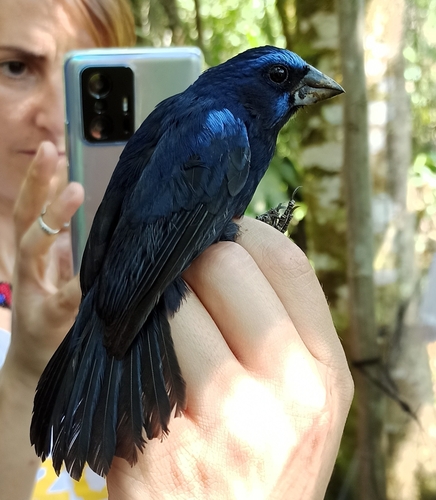 Amazonian GrosbeakCyanoloxia rothschildiiThe Amazonian grosbeak is 14.5 to 15 cm (5.7 to 5.9 in) long and weighs 21.5 to 31 g (0.76 to 1.09 oz).
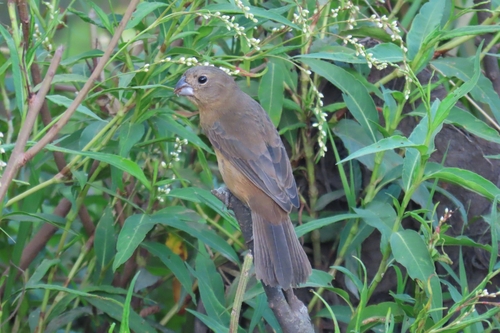 Glaucous-blue GrosbeakCyanoloxia glaucocaeruleaThe glaucous-blue grosbeak is approximately 14 cm (5.5 in) long.
Side by side: Blue-black Grosbeak vs Ultramarine Grosbeak · Amazonian Grosbeak vs Blue-black Grosbeak · Blue-black Grosbeak vs Glaucous-blue Grosbeak
Learn the Blue-black Grosbeak in the BeakBrain App
Photo and call practice. Coming soon to iPhone and Android.
Play today's Daily BirdEvery photo and recording on this page is credited to its author under the licence shown. Spotted a problem with this page, or have a better photo? Contribute.