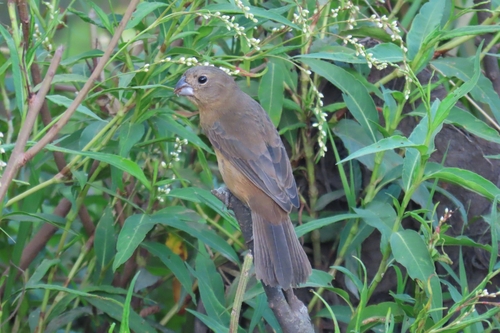
Glaucous-blue Grosbeak
Cyanoloxia glaucocaerulea
The glaucous-blue grosbeak is approximately 14 cm (5.5 in) long. Three birds weighed from 16 to 19.5 g (0.56 to 0.69 oz). The male is generally dark sky blue that is lighter on the forehead and rump and is grayish on the lower belly. It has a small black "mask". The female is brown overall, warm and dark above and orange-tinged below. The immature is orange-brown that is darker on the back, and it has a hint of blue on the forehead and cheek. Voice: The glaucous-blue grosbeak usually sings from dense cover, "a fast, high, hurried jumbled warbling" . Its call is "psit" or "jit" .
ID text from Wikipedia, CC BY-SA 4.0

Ultramarine Grosbeak
Cyanoloxia brissonii
These birds are 15 cm long. Adult males exhibit a dark-blue plumage with bright-blue highlights on the head and upper-wings and black on the face, wings and tail. The females and the juveniles are brown. Both sexes show black legs and large, thick bill. The Ultramarine Grosbeak is sedentary, only noted to have short-distance local migrations. Individuals of this species are solitary and often territorial, rarely associating with conspecifics or loosely aggregating in mixed-species flocks.
ID text from Wikipedia, CC BY-SA 4.0

Where you might meet both
Learn this pair in the BeakBrain App
Photo and call practice. Coming soon to iPhone and Android.
Play today's Daily BirdPhotos and recordings are credited to their authors under the licence shown. Full profiles: Glaucous-blue Grosbeak and Ultramarine Grosbeak.