Learn what every symbol on the card means.Full credits and sources at beakbrain.com/symbols
 ShrublandScrapeMedium · 67 g


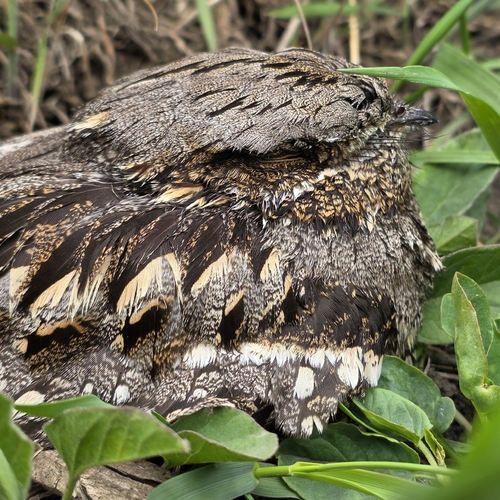
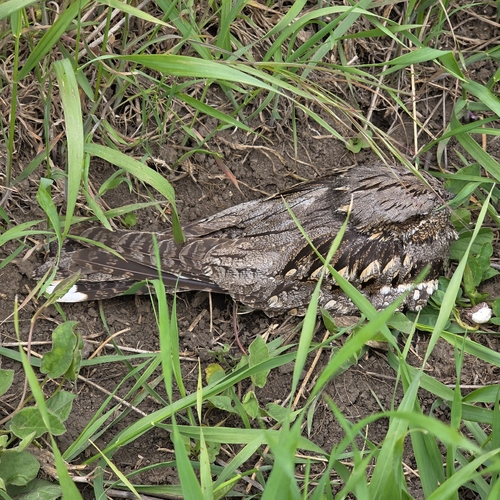


What the European Nightjar sounds like


ID tip
The European nightjar is 24.5–28 cm (9.6–11.0 in) long, with a 52–59 cm (20–23 in) wingspan. The male weighs 51–101 g (1.8–3.6 oz) and the female 67–95 g (2.4–3.4 oz). The adult of the nominate subspecies has greyish-brown upperparts with dark streaking, a pale buff hindneck collar and a white moustachial line. The closed wing is grey with buff spotting, and the underparts are greyish-brown, with brown barring and buff spots. The bill is blackish, the iris is dark brown and the legs and feet are brown. The flight on long pointed wings is noiseless, due to their soft plumage, and very buoyant. Voice: The male European nightjar's song is a sustained churring trill, given continuously for up to 10 minutes with occasional shifts of speed or pitch. It is delivered from a perch, and the male may move around its territory using different song posts. Singing is more frequent at dawn and dusk than during the night, and is reduced in poor weather.
Text from Wikipedia, licensed CC BY-SA 4.0.
When to see the European Nightjar
One bar for each month. Filled bars are the 5 months with records; pale bars are months with none. The wide bar is June, the month with the most records.
Where to see the European Nightjar
The map shades 89 countries with regular records, and 2 more in a lighter tone where the bird turns up only as a stray. Everything unshaded has no records. Countries are listed below the map.
About the European Nightjar
The European nightjar, common goatsucker, Eurasian nightjar or just nightjar is a crepuscular and nocturnal bird in the nightjar family that breeds across most of Europe and the Palearctic to Mongolia and Northwestern China. The Latin generic name refers to the old myth that the nocturnal nightjar suckled from goats, causing them to cease to give milk. The six subspecies differ clinally, the birds becoming smaller and paler towards the east of the range. All populations are migratory, wintering in sub-Saharan Africa.
Text adapted from Wikipedia, licensed CC BY-SA 4.0.
Easily confused with
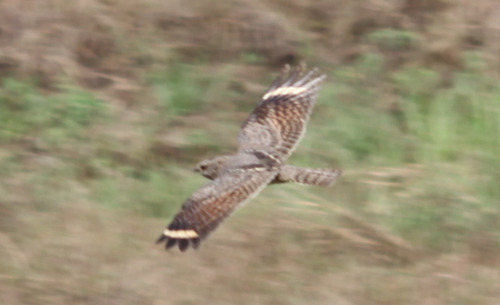 Savanna NightjarCaprimulgus affinisThe savanna nightjar measures 20-26cm in length, has a body weight of 54-110g, and a wingspan of 64cm, with size varying by subspecies, ranging from small to medium-large.
 Fiery-necked NightjarCaprimulgus pectoralisAn adult fiery-necked nightjar is relatively small measuring between 23 and 25 centimeters.
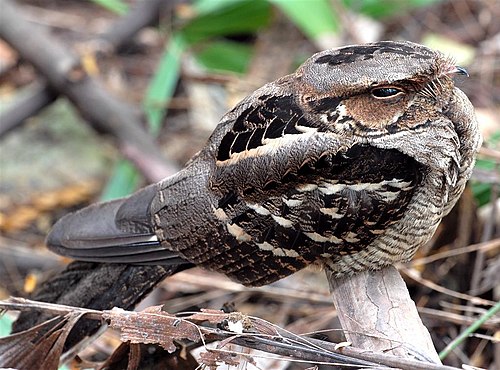 Large-tailed NightjarCaprimulgus macrurusThe large-tailed nightjar measures approximately 31.5 to 33 cm in length.
Side by side: European Nightjar vs Savanna Nightjar · European Nightjar vs Fiery-necked Nightjar · European Nightjar vs Large-tailed Nightjar
Learn the European Nightjar in the BeakBrain App
Photo and call practice. Coming soon to iPhone and Android.
Play today's Daily BirdEvery photo and recording on this page is credited to its author under the licence shown. Spotted a problem with this page, or have a better photo? Contribute.