Learn what every symbol on the card means.Full credits and sources at beakbrain.com/symbols
 WetlandPlatform nestLarge · 717 g


What the Eurasian Coot sounds like


ID tip
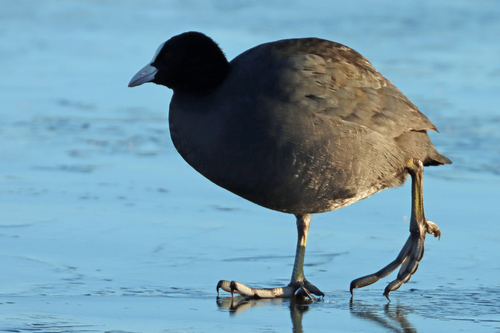
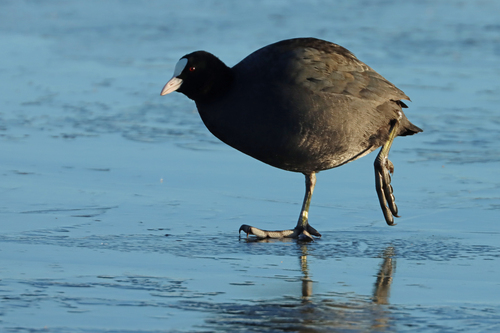
The Eurasian coot is 36–38 cm (14–15 in) in length with a wing-span of 70–80 cm (28–31 in); males weigh around 890 g (31 oz) and females 750 g (26 oz). It is largely black except for the white bill and frontal shield (which gives rise to the phrase "as bald as a coot", in use as early as 1430). As a swimming species, the coot has partial webbing on its long, strong toes. The sexes are similar in appearance.
Text from Wikipedia, licensed CC BY-SA 4.0.
When to see the Eurasian Coot
One bar for each month, and every month is filled: this bird is recorded here in all twelve. The wide bar is April, the month with the most records.
Where to see the Eurasian Coot
The map shades 105 countries with regular records, and 5 more in a lighter tone where the bird turns up only as a stray. Everything unshaded has no records. Countries are listed below the map.
Recorded as a rare visitor in United States, Canada, Sudan, Gambia, Niger.
About the Eurasian Coot
The Eurasian coot, also known as the common coot or Australian coot, is a member of the rail and crake bird family, the Rallidae. It is found in Europe, Asia, Australia, New Zealand and parts of North Africa. It has a slaty-black body, a glossy black head and a white bill with a white frontal shield. The sexes are similar in appearance.
Text adapted from Wikipedia, licensed CC BY-SA 4.0.
Easily confused with
 American CootFulica americanaThe American coot measures 34–43 cm (13–17 in) in length with a wingspan of 58 to 71 cm (23 to 28 in).
 Red-knobbed CootFulica cristataThe red-knobbed coot is largely black except for the white frontal shield.
 Red-gartered CootFulica armillataThe red-gartered coot is 43 to 51 cm (17 to 20 in) long.
Side by side: American Coot vs Eurasian Coot · Eurasian Coot vs Red-knobbed Coot · Eurasian Coot vs Red-gartered Coot
Learn the Eurasian Coot in the BeakBrain App
Photo and call practice. Coming soon to iPhone and Android.
Play today's Daily BirdEvery photo and recording on this page is credited to its author under the licence shown. Spotted a problem with this page, or have a better photo? Contribute.