Learn what every symbol on the card means.Full credits and sources at beakbrain.com/symbols
 WetlandPlatform nestLarge · 826 g




What the Red-knobbed Coot sounds like

ID tip
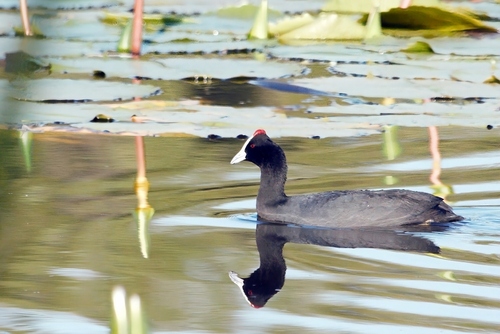
The red-knobbed coot is largely black except for the white frontal shield. It is 35–42 cm (14–17 in) long, spans 75–85 cm (30–33 in) across the wings. Males weigh 770–910 g (27–32 oz), females are slightly smaller and weigh 455–790 g (16.0–27.9 oz). The sexes are alike. As a swimming species, it has partial webbing on its long strong toes. The juvenile is paler than the adult, has a whitish breast, and lacks the facial shield; the adult's black plumage develops when about 3–4 months old, but the white shield is only fully developed at about one year old, some time later.
Text from Wikipedia, licensed CC BY-SA 4.0.
When to see the Red-knobbed Coot
One bar for each month, and every month is filled: this bird is recorded here in all twelve. The wide bar is January, the month with the most records.
Where to see the Red-knobbed Coot
The map shades 26 countries with regular records, and 1 more in a lighter tone where the bird turns up only as a stray. Everything unshaded has no records. Countries are listed below the map.
Recorded as a rare visitor in France.
About the Red-knobbed Coot
The red-knobbed coot or crested coot is a member of the rail and crake bird family, the Rallidae.
Text adapted from Wikipedia, licensed CC BY-SA 4.0.
Easily confused with
 Red-gartered CootFulica armillataThe red-gartered coot is 43 to 51 cm (17 to 20 in) long.
 White-winged CootFulica leucopteraThe white-winged coot is 35 to 43 cm (14 to 17 in) long and weighs about 400 to 600 g (14 to 21 oz).
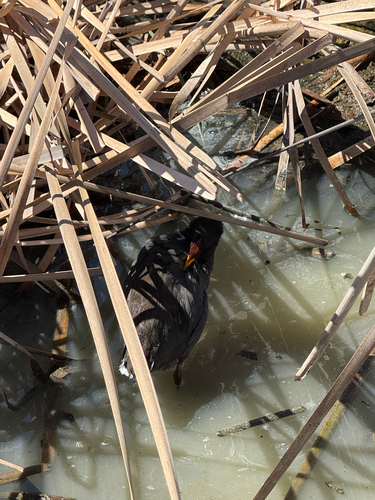 Red-fronted CootFulica rufifronsThe red-fronted coot is 38 to 43 cm (15 to 17 in) long.
Side by side: American Coot vs Red-knobbed Coot · Eurasian Coot vs Red-knobbed Coot · Corn Crake vs Red-knobbed Coot · Red-gartered Coot vs Red-knobbed Coot · Red-knobbed Coot vs White-winged Coot · Red-fronted Coot vs Red-knobbed Coot
Learn the Red-knobbed Coot in the BeakBrain App
Photo and call practice. Coming soon to iPhone and Android.
Play today's Daily BirdEvery photo and recording on this page is credited to its author under the licence shown. Spotted a problem with this page, or have a better photo? Contribute.