Learn what every symbol on the card means.Full credits and sources at beakbrain.com/symbols
 WetlandPlatform nestLarge · 637 g


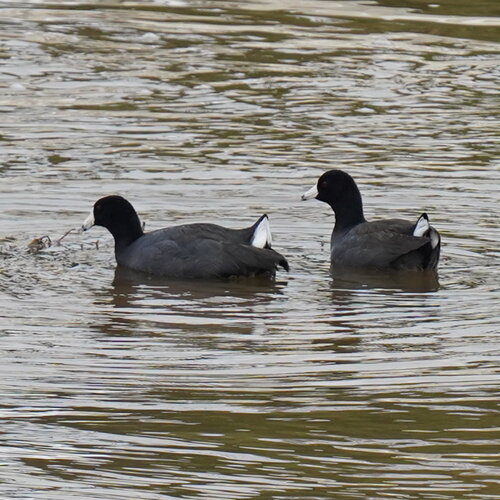
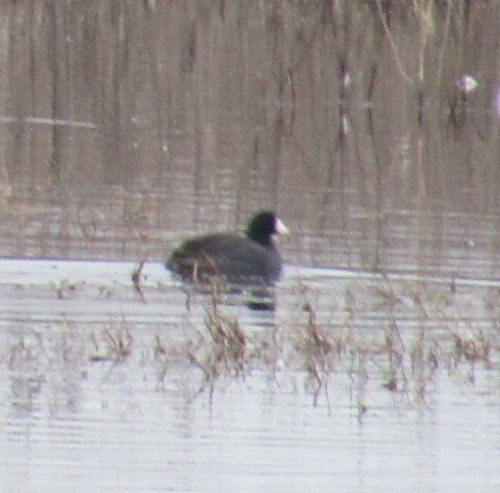
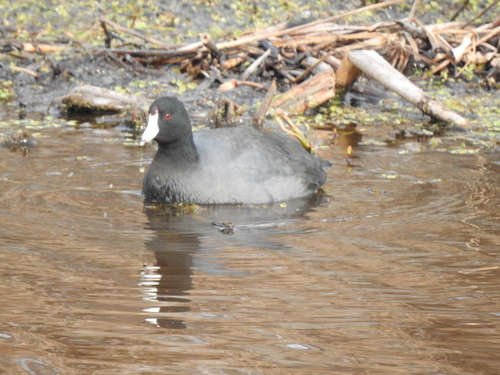
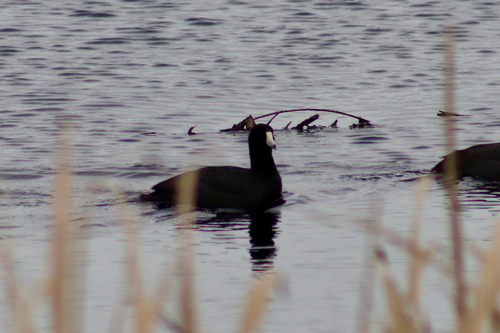
ID tip
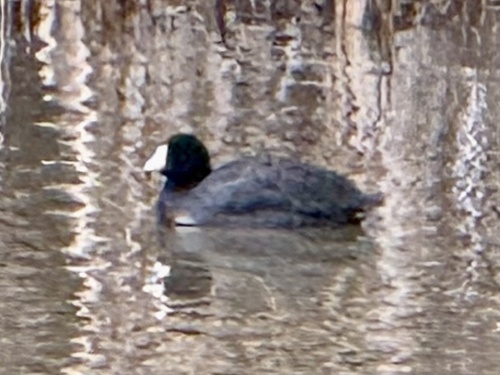
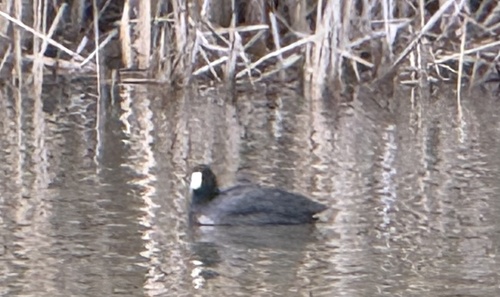
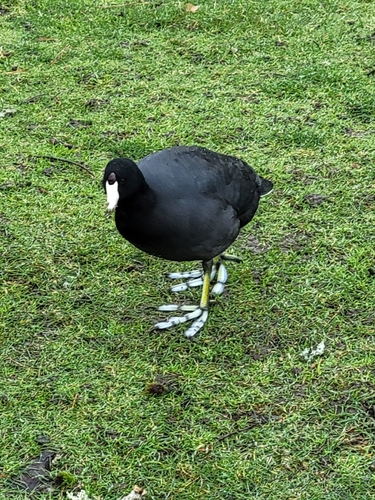
The American coot measures 34–43 cm (13–17 in) in length with a wingspan of 58 to 71 cm (23 to 28 in). Adults have a short, thick, white bill and white frontal shield, which usually has a reddish-brown spot near the top of the bill between the eyes. Males and females look alike, but females are smaller. Body mass in females ranges from 427 to 628 g (0.941 to 1.385 lb) and in males from 576 to 848 g (1.270 to 1.870 lb). Juvenile birds have olive-brown crowns and a gray body. They become adult-colored around 4 months of age. Voice: The American coot has a variety of repeated calls and sounds. Male and female coots make different types of calls to similar situations. Male alarm calls are puhlk while female alarm calls are poonk. Also, stressed males go puhk-cowah or pow-ur while females call cooah.
Text from Wikipedia, licensed CC BY-SA 4.0.
When to see the American Coot
One bar for each month. Filled bars are the 9 months with records; pale bars are months with none. The wide bar is April, the month with the most records.
Where to see the American Coot
The map shades 45 countries with regular records, and 3 more in a lighter tone where the bird turns up only as a stray. Everything unshaded has no records. Countries are listed below the map.
Recorded as a rare visitor in United Kingdom, Spain, France.
About the American Coot
The American coot, also known as a mud hen or pouldeau, is a bird of the family Rallidae. Though commonly mistaken for ducks, American coots are only distantly related to ducks, belonging to a separate order. Unlike the webbed feet of ducks, coots have broad, lobed scales on their lower legs and toes that fold back with each step to facilitate walking on dry land. Coots live near water, typically inhabiting wetlands and open water bodies in North America. Groups of coots are called covers or rafts. The oldest known coot lived to be 22 years old.
Text adapted from Wikipedia, licensed CC BY-SA 4.0.
Easily confused with
 Eurasian CootFulica atraThe Eurasian coot is 36–38 cm (14–15 in) in length with a wing-span of 70–80 cm (28–31 in); males weigh around 890 g (31 oz) and females 750 g (26 oz).
 Red-knobbed CootFulica cristataThe red-knobbed coot is largely black except for the white frontal shield.
 Red-gartered CootFulica armillataThe red-gartered coot is 43 to 51 cm (17 to 20 in) long.
Side by side: American Coot vs Eurasian Coot · American Coot vs Red-knobbed Coot · American Coot vs Red-gartered Coot
Learn the American Coot in the BeakBrain App
Photo and call practice. Coming soon to iPhone and Android.
Play today's Daily BirdEvery photo and recording on this page is credited to its author under the licence shown. Spotted a problem with this page, or have a better photo? Contribute.