Learn what every symbol on the card means.Full credits and sources at beakbrain.com/symbols
 ShrublandCup nestMedium · 63 g


ID tip
The bird grows to 32 centimetres (13 in), and has a deeply curved bill. The eyes are dull yellow. Bird expert Roger Tory Peterson described its singing as sweeter and less spasmodic than other thrashers. It can be found near desert streams in dense underbrush, mesquite thickets, willows, scrub oak, high elevations in manzanita, and in the low desert near canyon chaparral. The bird seldom flies in the open. As such, the crissal thrasher rarely flies, preferring to walk or run around its territory and will mostly run for cover when disturbed by a potential predator.
Text from Wikipedia, licensed CC BY-SA 4.0.
When to see the Crissal Thrasher
One bar for each month, and every month is filled: this bird is recorded here in all twelve. The wide bar is January, the month with the most records.
Where to see the Crissal Thrasher
The map shades 2 countries with regular records. Everything unshaded has no records. Countries are listed below the map.
About the Crissal Thrasher
The crissal thrasher is a large thrasher found in the Southwestern United States to central Mexico.
Text adapted from Wikipedia, licensed CC BY-SA 4.0.
Easily confused with
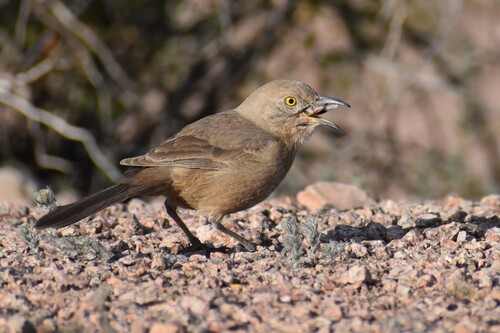 Bendire's ThrasherToxostoma bendireiBecause of its similar coloration and structure to the curve-billed thrasher, the two birds are very easy to mistake for one another.
 LeConte's ThrasherToxostoma leconteiLeConte's thrasher weighs from 55 to 75 g (1.9 to 2.6 oz) and are 24.5–29 cm (9.6–11.4 in), and there is no sexual dimorphism within the species.
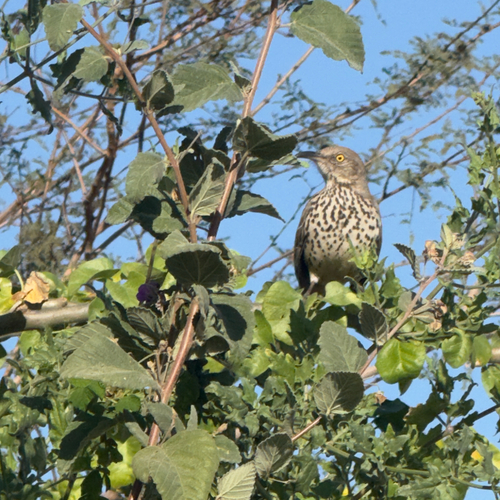 Grey ThrasherToxostoma cinereumThe gray thrasher is 21.4 to 25.0 cm (8.4 to 9.8 in) long.
Side by side: Crissal Thrasher vs Curve-billed Thrasher · California Thrasher vs Crissal Thrasher · Crissal Thrasher vs Long-billed Thrasher · Crissal Thrasher vs Sage Thrasher · Crissal Thrasher vs Pearly-eyed Thrasher · Bendire's Thrasher vs Crissal Thrasher · Crissal Thrasher vs LeConte's Thrasher · Crissal Thrasher vs Grey Thrasher
Learn the Crissal Thrasher in the BeakBrain App
Photo and call practice. Coming soon to iPhone and Android.
Play today's Daily BirdEvery photo and recording on this page is credited to its author under the licence shown. Spotted a problem with this page, or have a better photo? Contribute.