Learn what every symbol on the card means.Full credits and sources at beakbrain.com/symbols
 ShrublandCup nestMedium · 62 g

ID tip
LeConte's thrasher weighs from 55 to 75 g (1.9 to 2.6 oz) and are 24.5–29 cm (9.6–11.4 in), and there is no sexual dimorphism within the species. Their wings are typical of birds that are sedentary, as they are short and rounded. There are noted differences among the subspecies. The crown, back, shoulders, and rump of T.c. lecontei possess a sandy pale-gray color. The primaries and secondaries are grayish brown. The rectrices are of a darker gray brown that contrasts with the plumage. Lores and ear-coverts are a mottled gray brown. The throat is an off-whitish color of a darker stripe. Voice: The song is a large, prolonged outpouring of warbled phrases that can be repeated two or several times and can be heard from considerable distances, which is typical of the genus Toxostoma. The song starts softly, then increases in volume, and has a more measured delivery than that of the crissal thrasher.
Text from Wikipedia, licensed CC BY-SA 4.0.
When to see the LeConte's Thrasher
One bar for each month, and every month is filled: this bird is recorded here in all twelve. The wide bar is March, the month with the most records.
Where to see the LeConte's Thrasher
The map shades 2 countries with regular records. Everything unshaded has no records. Countries are listed below the map.
About the LeConte's Thrasher
LeConte's thrasher is a pale bird found in the southwestern United States and northwestern Mexico. It prefers to live in deserts with very little vegetation, where it blends in with the sandy soils. LeConte's thrashers are nonmigratory birds that reside in the same territory annually. Although the species has been decreasing in certain areas of its range, in particular California, it still is abundant enough to not be considered for vulnerable status.
Text adapted from Wikipedia, licensed CC BY-SA 4.0.
Easily confused with
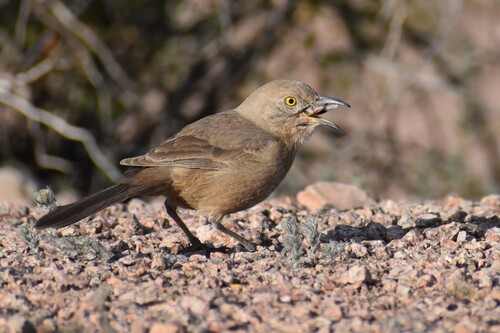 Bendire's ThrasherToxostoma bendireiBecause of its similar coloration and structure to the curve-billed thrasher, the two birds are very easy to mistake for one another.
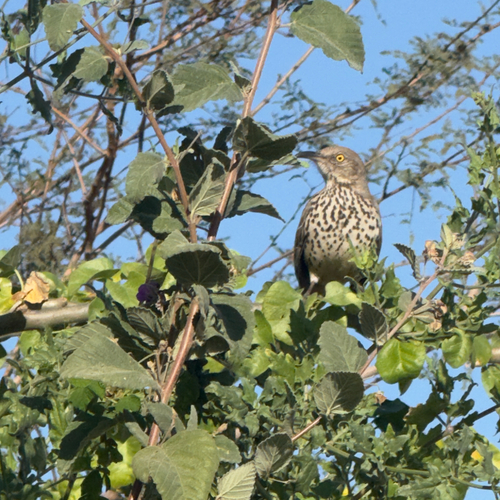 Grey ThrasherToxostoma cinereumThe gray thrasher is 21.4 to 25.0 cm (8.4 to 9.8 in) long.
 Ocellated ThrasherToxostoma ocellatumThe ocellated thrasher is 26.5 to 29.5 cm (10.4 to 11.6 in) long; 14 specimens weighed 77.3 to 95.8 g (2.73 to 3.38 oz).
Side by side: Crissal Thrasher vs LeConte's Thrasher · Bendire's Thrasher vs LeConte's Thrasher · LeConte's Thrasher vs Scaly-breasted Thrasher · Grey Thrasher vs LeConte's Thrasher
Learn the LeConte's Thrasher in the BeakBrain App
Photo and call practice. Coming soon to iPhone and Android.
Play today's Daily BirdEvery photo and recording on this page is credited to its author under the licence shown. Spotted a problem with this page, or have a better photo? Contribute.