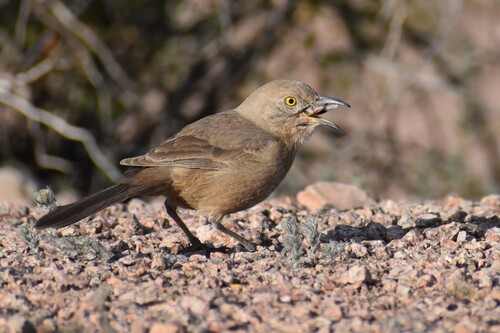
Bendire's Thrasher
Toxostoma bendirei
Because of its similar coloration and structure to the curve-billed thrasher, the two birds are very easy to mistake for one another. The Bendire's thrasher's shorter bill is a distinguishing feature when comparing mature birds, but it is still easy to misidentify an adult Bendire's thrasher as a young curve-billed thrasher as its beak has not grown to a mature length. The Bendire's thrasher's yellow eyes and pale-based lower mandible are additional markings which aid in separation from the curve-billed thrasher. Voice: Like other mimids, the often silent Bendire's thrasher incorporates the songs and calls of other species into its own songs. A sharp "chek" is the species' most common call.
ID text from Wikipedia, CC BY-SA 4.0


LeConte's Thrasher
Toxostoma lecontei
LeConte's thrasher weighs from 55 to 75 g (1.9 to 2.6 oz) and are 24.5–29 cm (9.6–11.4 in), and there is no sexual dimorphism within the species. Their wings are typical of birds that are sedentary, as they are short and rounded. There are noted differences among the subspecies. The crown, back, shoulders, and rump of T.c. lecontei possess a sandy pale-gray color. The primaries and secondaries are grayish brown. The rectrices are of a darker gray brown that contrasts with the plumage. Lores and ear-coverts are a mottled gray brown. The throat is an off-whitish color of a darker stripe. Voice: The song is a large, prolonged outpouring of warbled phrases that can be repeated two or several times and can be heard from considerable distances, which is typical of the genus Toxostoma. The song starts softly, then increases in volume, and has a more measured delivery than that of the crissal thrasher.
ID text from Wikipedia, CC BY-SA 4.0
Where you might meet both
Learn this pair in the BeakBrain App
Photo and call practice. Coming soon to iPhone and Android.
Play today's Daily BirdPhotos and recordings are credited to their authors under the licence shown. Full profiles: Bendire's Thrasher and LeConte's Thrasher.