
Crissal Thrasher
Toxostoma crissale
The bird grows to 32 centimetres (13 in), and has a deeply curved bill. The eyes are dull yellow. Bird expert Roger Tory Peterson described its singing as sweeter and less spasmodic than other thrashers. It can be found near desert streams in dense underbrush, mesquite thickets, willows, scrub oak, high elevations in manzanita, and in the low desert near canyon chaparral. The bird seldom flies in the open. As such, the crissal thrasher rarely flies, preferring to walk or run around its territory and will mostly run for cover when disturbed by a potential predator.
ID text from Wikipedia, CC BY-SA 4.0
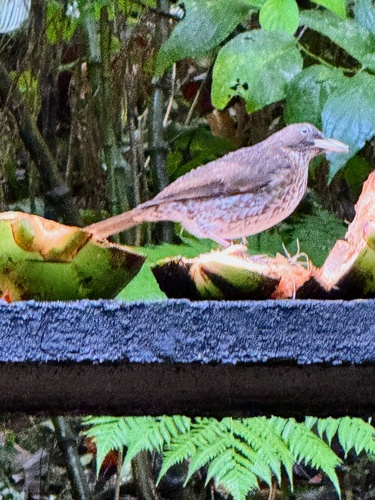
Pearly-eyed Thrasher
Margarops fuscatus
The pearly-eyed thrasher is the largest species in the Mimidae, growing to 28 to 30 cm (11 to 11.8 inches) in length.
ID text from Wikipedia, CC BY-SA 4.0
Learn this pair in the BeakBrain App
Photo and call practice. Coming soon to iPhone and Android.
Play today's Daily BirdPhotos and recordings are credited to their authors under the licence shown. Full profiles: Crissal Thrasher and Pearly-eyed Thrasher.