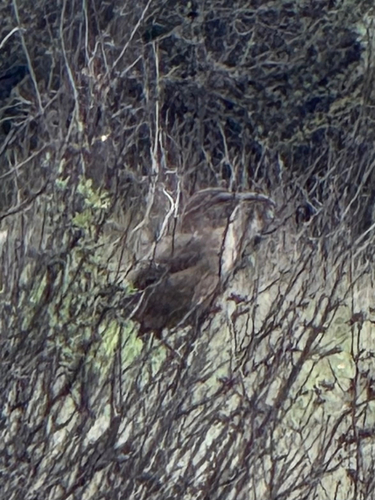
California Thrasher
Toxostoma redivivum
The California thrasher is about 32 cm (13 in) long and weighs up to 90 g (3.2 oz); it is the largest thrasher. It has a distinctive long, decurved beak and a long tail. It is generally deep grayish brown above with olive tones on the tail. It has a grayish buff supercilium, a dark cheek pattern and eye line, and unlike most thrashers, has dark eyes. The underparts are mostly buffy to tawny brown, with the upper breast and flanks a smoky gray. The two subspecies differ only slightly. Voice: The California thrasher is recognized as a "striking and exuberant songster" known for its mimicking capabilities. It imitates many of the species that share its habitat, a trait that has been documented as reflecting a rich vocal repertoire, showcasing a wide range of vocal imitations from other species.
ID text from Wikipedia, CC BY-SA 4.0


Crissal Thrasher
Toxostoma crissale
The bird grows to 32 centimetres (13 in), and has a deeply curved bill. The eyes are dull yellow. Bird expert Roger Tory Peterson described its singing as sweeter and less spasmodic than other thrashers. It can be found near desert streams in dense underbrush, mesquite thickets, willows, scrub oak, high elevations in manzanita, and in the low desert near canyon chaparral. The bird seldom flies in the open. As such, the crissal thrasher rarely flies, preferring to walk or run around its territory and will mostly run for cover when disturbed by a potential predator.
ID text from Wikipedia, CC BY-SA 4.0
Where you might meet both
Learn this pair in the BeakBrain App
Photo and call practice. Coming soon to iPhone and Android.
Play today's Daily BirdPhotos and recordings are credited to their authors under the licence shown. Full profiles: California Thrasher and Crissal Thrasher.