Learn what every symbol on the card means.Full credits and sources at beakbrain.com/symbols
 GrasslandPlatform nestMedium · 155 g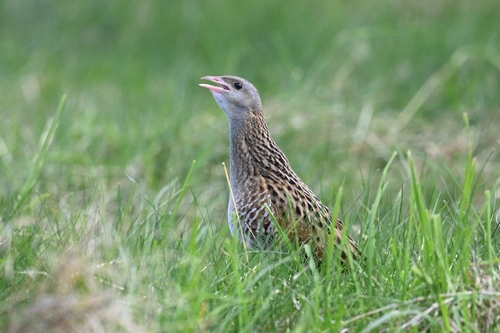


What the Corn Crake sounds like


ID tip
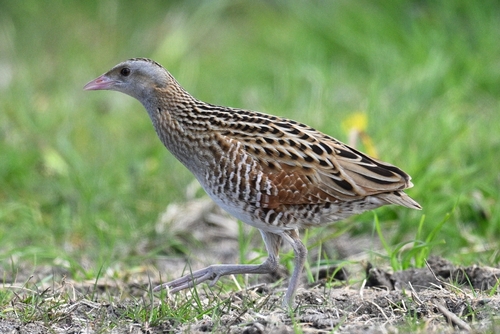
The corn crake is a medium-sized rail, 27–30 cm (11–12 in) long with a wingspan of 42–53 cm (17–21 in). Males weigh 165 g (5.8 oz) on average and females 145 g (5.1 oz). The adult male has the crown of its head and all of its upperparts brown-black in colour, streaked with buff or grey. The wing coverts are a distinctive chestnut colour with some white bars. The face, neck and breast are blue-grey, apart from a pale brown streak from the base of the bill to behind the eye, the belly is white, and the flanks, and undertail are barred with chestnut and white. Voice: On the breeding grounds, the male corn crake's advertising call is a loud, repetitive, grating krek krek normally delivered from a low perch with the bird's head and neck almost vertical and its bill wide open. The call can be heard from 1.5 km (0.93 mi) away, and serves to establish the breeding territory, attract females, and challenge intruding males.
Text from Wikipedia, licensed CC BY-SA 4.0.
When to see the Corn Crake
One bar for each month. Filled bars are the 3 months with records; pale bars are months with none. The wide bar is June, the month with the most records.
Where to see the Corn Crake
The map shades 66 countries with regular records, and 9 more in a lighter tone where the bird turns up only as a stray. Everything unshaded has no records. Countries are listed below the map.
Recorded as a rare visitor in United States, Spain, Portugal, India, Canada, Rwanda, Botswana, Brazil, Syria.
About the Corn Crake
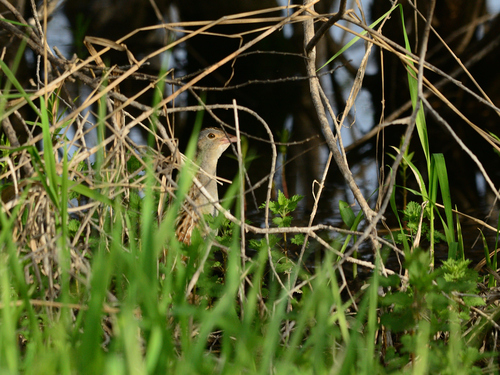
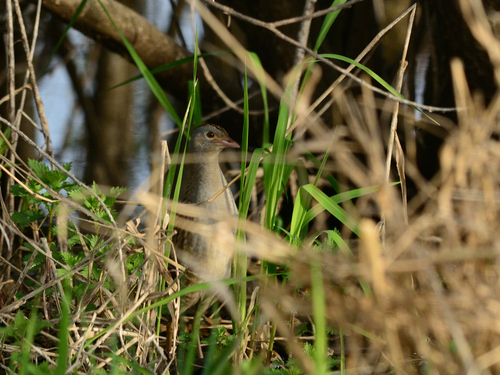
The corn crake, corncrake or landrail is a bird in the rail family. It breeds in Europe and Asia as far east as western China, and migrates to Africa for the Northern Hemisphere's winter. It is a medium-sized crake with buff- or grey-streaked brownish-black upperparts, chestnut markings on the wings, and blue-grey underparts with rust-coloured and white bars on the flanks and undertail. The strong bill is flesh-toned, the iris is pale brown, and the legs and feet are pale grey. Juveniles are similar in plumage to adults, and downy chicks are black, as with all rails.
Text adapted from Wikipedia, licensed CC BY-SA 4.0.
Easily confused with
 Red-knobbed CootFulica cristataThe red-knobbed coot is largely black except for the white frontal shield.
 Grey-cowled Wood RailAramides cajaneusThe grey-cowled wood rail usually measures 33–40 centimetres (13–16 in) long and weighs 320–465 grams (11.3–16.4 oz), particularly large for a wood rail.
 Red-gartered CootFulica armillataThe red-gartered coot is 43 to 51 cm (17 to 20 in) long.
Side by side: Corn Crake vs Red-knobbed Coot · Corn Crake vs Grey-cowled Wood Rail · Corn Crake vs Red-gartered Coot
Learn the Corn Crake in the BeakBrain App
Photo and call practice. Coming soon to iPhone and Android.
Play today's Daily BirdEvery photo and recording on this page is credited to its author under the licence shown. Spotted a problem with this page, or have a better photo? Contribute.