Learn what every symbol on the card means.Full credits and sources at beakbrain.com/symbols
 ForestCup nestLarge · 397 g


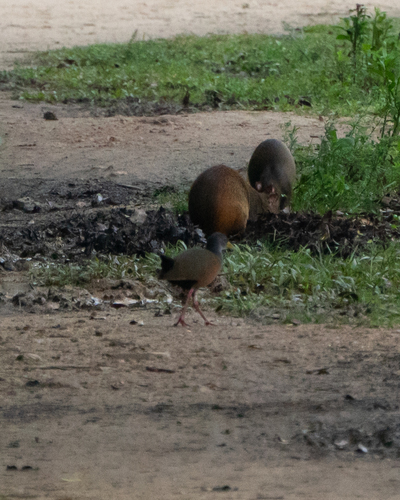
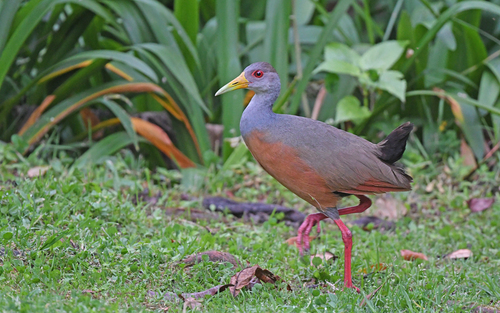
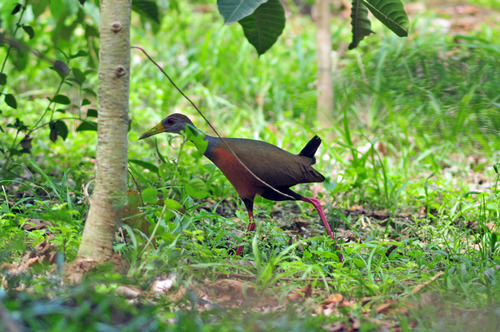
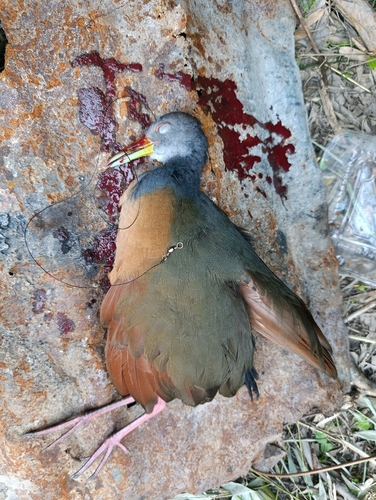
What the Grey-cowled Wood Rail sounds like

ID tip
The grey-cowled wood rail usually measures 33–40 centimetres (13–16 in) long and weighs 320–465 grams (11.3–16.4 oz), particularly large for a wood rail. The upperparts are olive-green to dark brown. The head and neck are medium-grey, blending into a brown patch at the back of the head. The eyes are red. The chest and flanks are rufous. The belly, rump, and tail are black. The legs are coral-red, while the bill is a bright greenish-yellow. The males and females are similar. Juvenile birds are similar to the adult but are duller in colour, with their belly sooty-black and flecked with buff. Voice: The grey-cowled wood rail has a loud, repetitive cackling call mainly heard at dawn and dusk: pop-tiyi pop-tiyi co-co-co-co-co or chitico chitico cao-cao-cao. These songs are often sung in a chorus or duet. The alarm call is a harsh, loud cackle or clucking shriek. The chitico chitico cao-cao-cao call made by this rail is similar to the brown wood rail's kui-ko call.
Text from Wikipedia, licensed CC BY-SA 4.0.
When to see the Grey-cowled Wood Rail
One bar for each month, and every month is filled: this bird is recorded here in all twelve. The wide bar is October, the month with the most records.
Where to see the Grey-cowled Wood Rail
The map shades 15 countries with regular records, and 2 more in a lighter tone where the bird turns up only as a stray. Everything unshaded has no records. Countries are listed below the map.
About the Grey-cowled Wood Rail
The grey-cowled wood rail or grey-necked wood rail is a species of bird in the family Rallidae, the rails. It lives primarily in the forests, mangroves, and swamps of Central and South America. Of the two subspecies, A. c. avicenniae is found in southeastern Brazil, while the nominate is found throughout the portion of the range not occupied by the other subspecies. The species as a whole is usually found at elevations from sea level to 2,000 metres (6,600 ft), although some have been found above that. This bird's large range, along with its significant population, is why it is considered to be least-concern by the International Union for Conservation of Nature (IUCN).
Text adapted from Wikipedia, licensed CC BY-SA 4.0.
Easily confused with
 Giant Wood RailAramides ypecahaThe giant wood rail is 41 to 45 cm (16 to 18 in) long, and possibly as long as 53 cm (21 in).
 Slaty-breasted Wood RailAramides saracuraThe slaty-breasted wood rail is 34 to 37 cm (13 to 15 in) long; one male weighed 540 g (19 oz).
 Russet-naped Wood RailAramides albiventrisThe russet-naped wood rail is 33 to 40 cm (13 to 16 in) long and weighs about 450 to 600 g (16 to 21 oz).
Side by side: Corn Crake vs Grey-cowled Wood Rail · Giant Wood Rail vs Grey-cowled Wood Rail · Grey-cowled Wood Rail vs Slaty-breasted Wood Rail · Grey-cowled Wood Rail vs Russet-naped Wood Rail
Learn the Grey-cowled Wood Rail in the BeakBrain App
Photo and call practice. Coming soon to iPhone and Android.
Play today's Daily BirdEvery photo and recording on this page is credited to its author under the licence shown. Spotted a problem with this page, or have a better photo? Contribute.