Learn what every symbol on the card means.Full credits and sources at beakbrain.com/symbols
 WoodlandPlatform nestLarge · 490 g


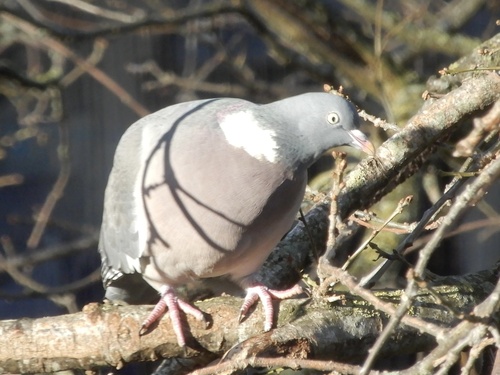
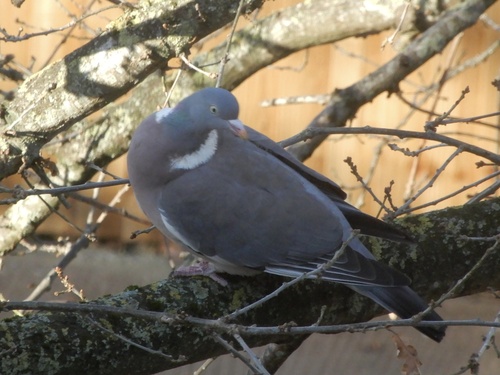
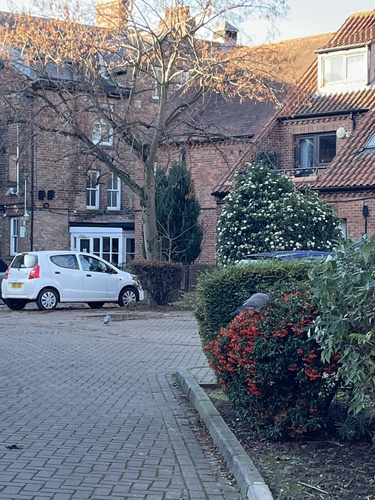
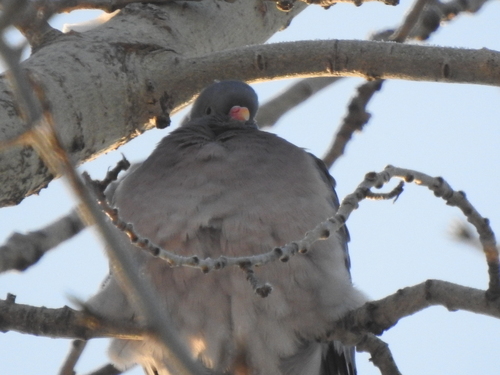
What the Common Wood Pigeon sounds like


ID tip
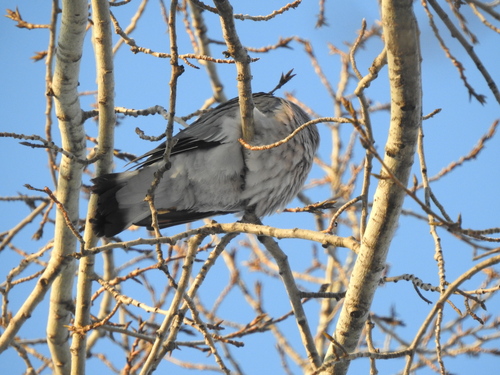
The three Western European Columba pigeons, common wood pigeon, stock dove and rock dove, though superficially alike, have very distinctive characteristics; the common wood pigeon may be identified at once by its larger size at 38–44.5 cm (15–17+1⁄2 in) and weight 300–615 g (10+5⁄8–21+3⁄4 oz), and the white on its neck and wing. It is otherwise a basically grey bird, with a pinkish breast. The wingspan can range from 68 to 80 cm (27 to 31 in) and the wing chord measures 24 to 25.4 cm (9+1⁄2 to 10 in). The tail measures 13.8 to 15 cm (5+1⁄2 to 6 in), the bill is 1.9 to 2. Voice: The call of the wood pigeon is a monotonous five-syllable characteristic cooing phrase, "oooh, oooh, ooh, ooooh, ooh", usually repeated several times. In Ireland and the UK, the traditional mnemonic for this repeated cooing phrase has been interpreted as "Take two cows, Teddy", or "Take two cows, Taffy".
Text from Wikipedia, licensed CC BY-SA 4.0.
When to see the Common Wood Pigeon
One bar for each month. Filled bars are the 11 months with records; pale bars are months with none. The wide bar is May, the month with the most records.
Where to see the Common Wood Pigeon
The map shades 79 countries with regular records, and 2 more in a lighter tone where the bird turns up only as a stray. Everything unshaded has no records. Countries are listed below the map.
About the Common Wood Pigeon
The common wood pigeon, also known simply as the wood pigeon, is a large pigeon native to the western Palearctic. It belongs to the genus Columba, which includes closely related species such as the rock dove. It has a flexible diet, feeding mainly on plant material, including cereals, and is therefore considered an agricultural pest. Wood pigeons are extensively hunted over much of their range, but this does not appear to have a major impact on their population numbers.
Text adapted from Wikipedia, licensed CC BY-SA 4.0.
Easily confused with
 Stock DoveColumba oenasThe stock dove is 28–34 cm (11–13 in) long, with a wingspan of 60–66 cm (24–26 in) and a weight of 303–365 g in males, 286–290 g in females.
 Speckled PigeonColumba guineaIt is a medium-sized pigeon, at 32–35 cm in length similar in size to rock dove and stock dove.
 African Olive PigeonColumba arquatrixThe adult male African olive pigeon is a large pigeon at 37 to 42 cm (15 to 17 in) in length and a weight of 300 to 450 g (11 to 16 oz).
Side by side: Common Wood Pigeon vs Rock Dove · Common Wood Pigeon vs Stock Dove · Common Wood Pigeon vs Speckled Pigeon · African Olive Pigeon vs Common Wood Pigeon
Learn the Common Wood Pigeon in the BeakBrain App
Photo and call practice. Coming soon to iPhone and Android.
Play today's Daily BirdEvery photo and recording on this page is credited to its author under the licence shown. Spotted a problem with this page, or have a better photo? Contribute.