Learn what every symbol on the card means.Full credits and sources at beakbrain.com/symbols
 WoodlandCavity nestMedium · 291 g





What the Stock Dove sounds like


ID tip
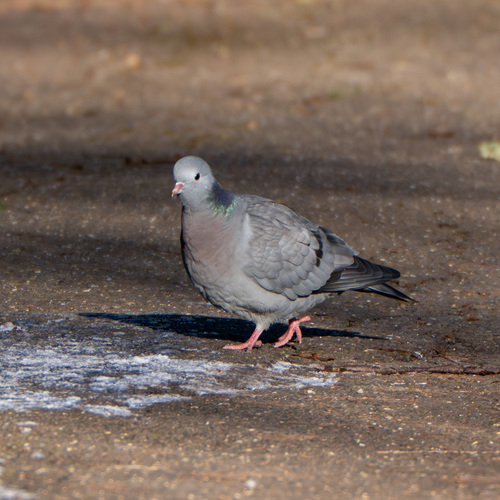
The stock dove is 28–34 cm (11–13 in) long, with a wingspan of 60–66 cm (24–26 in) and a weight of 303–365 g in males, 286–290 g in females. The plumage is a blue-toned grey, with two short dark grey to blackish wingbars on the tertials and greater coverts, and a broad dark grey bar at the tip of the tail. The breast is lightly suffused pinkish-purple, and the sides of the neck have an iridescent patch varying between green and purple depending on the angle of incident light. The eyes are dark, and the bill pink with a yellow tip.
Text from Wikipedia, licensed CC BY-SA 4.0.
When to see the Stock Dove
One bar for each month. Filled bars are the 10 months with records; pale bars are months with none. The wide bar is April, the month with the most records.
Where to see the Stock Dove
The map shades 62 countries with regular records, and 4 more in a lighter tone where the bird turns up only as a stray. Everything unshaded has no records. Countries are listed below the map.
Recorded as a rare visitor in Oman, Palestinian Territories, Andorra, Malta.
About the Stock Dove
The stock dove is a species of bird in the family Columbidae, the doves and pigeons. It is widely distributed in the western Palearctic, north to central Scandinavia and south to northwest Africa. Western and southern populations are resident, while northeastern populations are migratory to avoid the colder winters there. It is the type species of the genus Columba.
Text adapted from Wikipedia, licensed CC BY-SA 4.0.
Easily confused with
 Speckled PigeonColumba guineaIt is a medium-sized pigeon, at 32–35 cm in length similar in size to rock dove and stock dove.
 African Olive PigeonColumba arquatrixThe adult male African olive pigeon is a large pigeon at 37 to 42 cm (15 to 17 in) in length and a weight of 300 to 450 g (11 to 16 oz).
 White-headed PigeonColumba leucomelaThe white-headed pigeon draws its name from its distinctive white head, neck, breast, and belly.
Side by side: Rock Dove vs Stock Dove · Common Wood Pigeon vs Stock Dove · Speckled Pigeon vs Stock Dove · African Olive Pigeon vs Stock Dove · Stock Dove vs White-headed Pigeon
Learn the Stock Dove in the BeakBrain App
Photo and call practice. Coming soon to iPhone and Android.
Play today's Daily BirdEvery photo and recording on this page is credited to its author under the licence shown. Spotted a problem with this page, or have a better photo? Contribute.