Learn what every symbol on the card means.Full credits and sources at beakbrain.com/symbols
 ForestPlatform nestLarge · 400 g


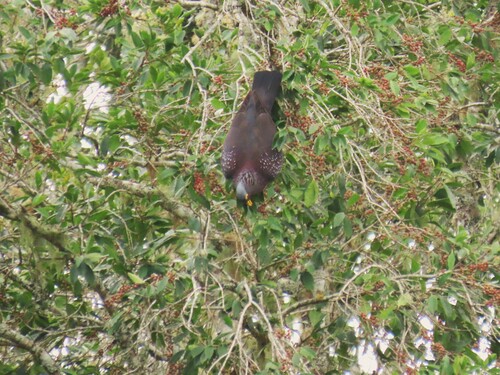
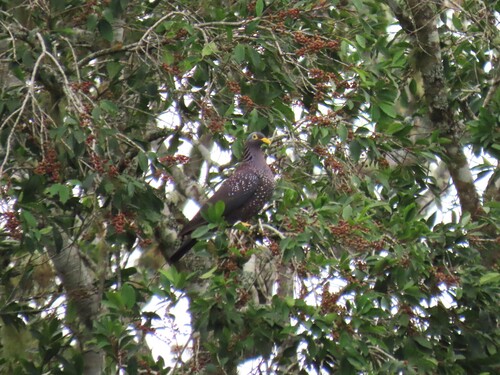
ID tip
The adult male African olive pigeon is a large pigeon at 37 to 42 cm (15 to 17 in) in length and a weight of 300 to 450 g (11 to 16 oz). Its back and wings are maroon, with the shoulders heavily speckled with white spots. The underparts are maroon with heavy white spotting, and the head is grey with yellow patches around the eye, and a yellow bill. The neck plumage, used in display, is streaked maroon and white, the underwing and undertail are dark grey, and the feet are yellow. Females are very similar to males but somewhat duller.
Text from Wikipedia, licensed CC BY-SA 4.0.
When to see the African Olive Pigeon
One bar for each month, and every month is filled: this bird is recorded here in all twelve. The wide bar is October, the month with the most records.
Where to see the African Olive Pigeon
The map shades 18 countries with regular records. Everything unshaded has no records. Countries are listed below the map.
About the African Olive Pigeon
The African olive pigeon or Rameron pigeon is a pigeon which is a resident breeding bird in much of eastern and southern Africa from Ethiopia to the Cape. Populations also are found in western Angola, southwestern Saudi Arabia and northern Yemen. It is locally common, although sizeable gaps in its distribution occur due to its habitat requirements. Despite this, the species is monotypic, with no substantive variation between birds in the different areas it occurs in.
Text adapted from Wikipedia, licensed CC BY-SA 4.0.
Easily confused with
 White-headed PigeonColumba leucomelaThe white-headed pigeon draws its name from its distinctive white head, neck, breast, and belly.
 Hill PigeonColumba rupestrisThe hill pigeon is a stout-bodied pigeon, similar in size and general appearance to the rock dove (Columba livia) but mainly differentiated by its tail pattern which consists of a broad, white tail-band across the black tail.
 Ashy Wood PigeonColumba pulchricollisThe ashy wood pigeon is a member of the bird family Columbidae, found in temperate forests of southeastern Asia.
Side by side: African Olive Pigeon vs Common Wood Pigeon · African Olive Pigeon vs Stock Dove · African Olive Pigeon vs Speckled Pigeon · African Olive Pigeon vs White-headed Pigeon · African Olive Pigeon vs Hill Pigeon
Learn the African Olive Pigeon in the BeakBrain App
Photo and call practice. Coming soon to iPhone and Android.
Play today's Daily BirdEvery photo and recording on this page is credited to its author under the licence shown. Spotted a problem with this page, or have a better photo? Contribute.