Learn what every symbol on the card means.Full credits and sources at beakbrain.com/symbols
 UrbanCavity nestMedium · 77 g

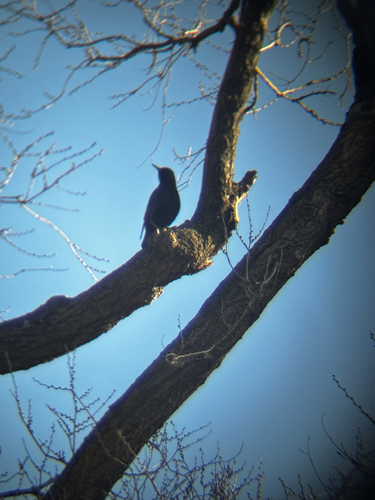
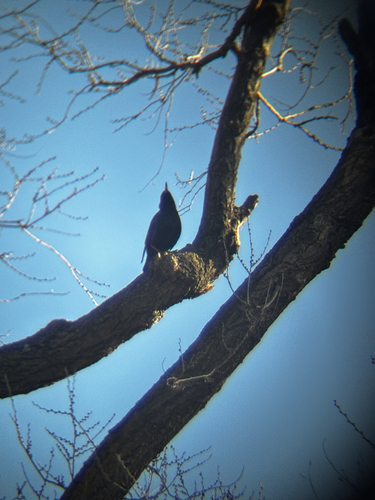
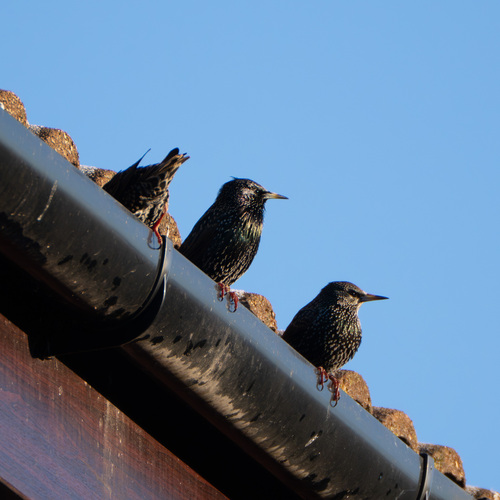




What the Common Starling sounds like


ID tip
The common starling is 19–23 cm (7.5–9.1 in) long, with a wingspan of 31–44 cm (12–17 in) and a weight of 58–101 g (2.0–3.6 oz). Among standard measurements, the wing chord is 11.8 to 13.8 cm (4.6 to 5.4 in), the tail is 5.8 to 6.8 cm (2.3 to 2.7 in), the culmen is 2.5 to 3.2 cm (0.98 to 1.26 in) and the tarsus is 2.7 to 3.2 cm (1.1 to 1.3 in). The plumage is iridescent black, glossed purple or green, and spangled with white, especially in winter. The underparts of adult male common starlings are less spotted than those of adult females at a given time of year. Voice: The common starling is noisy, its song consisting of a wide variety of both melodic and mechanical-sounding noises as part of a ritual succession of sounds. The male is the main songster and engages in bouts of song lasting for a minute or more. Each of these typically includes four varieties of song type, which follow each other in a regular order without pause.
Text from Wikipedia, licensed CC BY-SA 4.0.
When to see the Common Starling
One bar for each month, and every month is filled: this bird is recorded here in all twelve. The wide bar is May, the month with the most records.
Where to see the Common Starling
The map shades 118 countries with regular records, and 4 more in a lighter tone where the bird turns up only as a stray. Everything unshaded has no records. Countries are listed below the map.
Recorded as a rare visitor in Chile, Cambodia, Kenya, Aruba.
About the Common Starling
The common starling, also known simply as the starling in Great Britain and Ireland, and as the European starling in North America, is a medium-sized passerine bird in the starling family, Sturnidae. It is about 20 cm (8 in) long and has glossy black plumage with a metallic sheen, which is speckled with white at some times of the year. The legs are pink and the bill is black in winter and yellow in summer; young birds have browner plumage than the adults. Its gift for mimicry has been noted in literature including the Mabinogion and the works of Pliny the Elder and William Shakespeare.
Text adapted from Wikipedia, licensed CC BY-SA 4.0.
Easily confused with
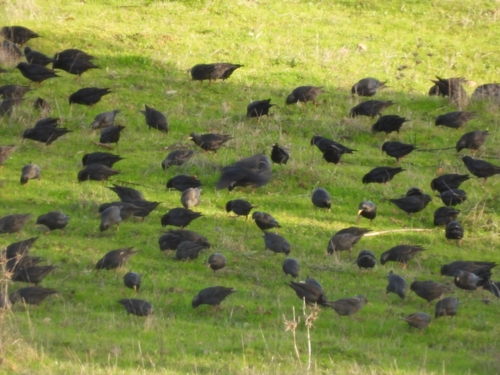
Side by side: Common Starling vs Spotless Starling
Learn the Common Starling in the BeakBrain App
Photo and call practice. Coming soon to iPhone and Android.
Play today's Daily BirdEvery photo and recording on this page is credited to its author under the licence shown. Spotted a problem with this page, or have a better photo? Contribute.