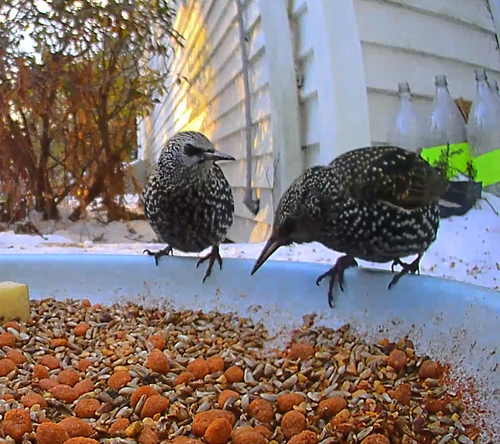
Common Starling
Sturnus vulgaris
The common starling is 19–23 cm (7.5–9.1 in) long, with a wingspan of 31–44 cm (12–17 in) and a weight of 58–101 g (2.0–3.6 oz). Among standard measurements, the wing chord is 11.8 to 13.8 cm (4.6 to 5.4 in), the tail is 5.8 to 6.8 cm (2.3 to 2.7 in), the culmen is 2.5 to 3.2 cm (0.98 to 1.26 in) and the tarsus is 2.7 to 3.2 cm (1.1 to 1.3 in). The plumage is iridescent black, glossed purple or green, and spangled with white, especially in winter. The underparts of adult male common starlings are less spotted than those of adult females at a given time of year. Voice: The common starling is noisy, its song consisting of a wide variety of both melodic and mechanical-sounding noises as part of a ritual succession of sounds. The male is the main songster and engages in bouts of song lasting for a minute or more. Each of these typically includes four varieties of song type, which follow each other in a regular order without pause.
ID text from Wikipedia, CC BY-SA 4.0

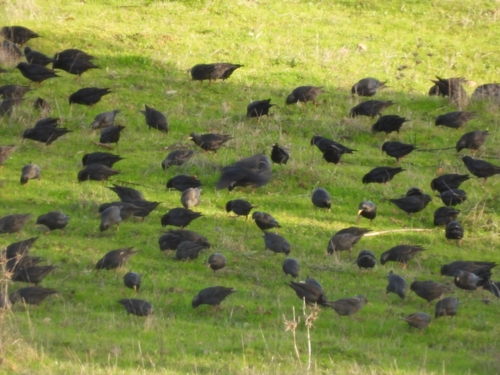
Spotless Starling
Sturnus unicolor
The adult spotless starling is very similar to the common starling, but marginally larger (21–23 cm length; 70–100 g weight), and has darker, oily-looking black plumage, slightly purple- or green-glossed in bright light, which is entirely spotless in spring and summer, and only with very small pale spots in winter plumage, formed by the pale tips of the feathers. It also differs in having conspicuously longer throat feathers (twice the length of those on common starlings), forming a shaggy "beard" which is particularly obvious when the bird is singing. Its legs are bright pink.
ID text from Wikipedia, CC BY-SA 4.0

Where you might meet both
Learn this pair in the BeakBrain App
Photo and call practice. Coming soon to iPhone and Android.
Play today's Daily BirdPhotos and recordings are credited to their authors under the licence shown. Full profiles: Common Starling and Spotless Starling.