Learn what every symbol on the card means.Full credits and sources at beakbrain.com/symbols
 CoastalCavity nestLarge · 1.1 kg




What the Common Shelduck sounds like


ID tip
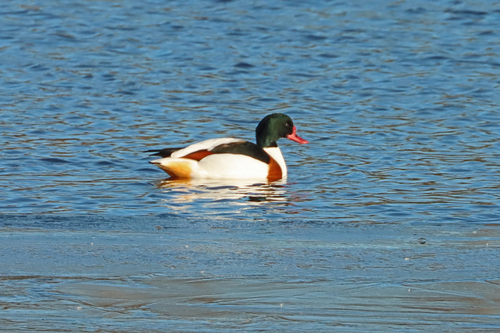
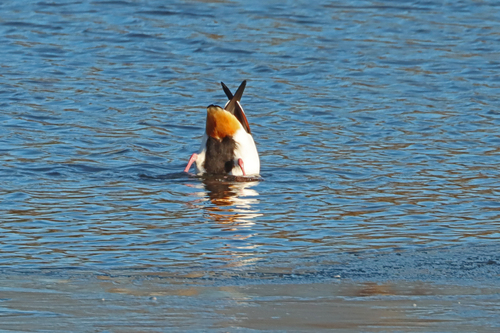
The common shelduck resembles a small short-necked goose in size and shape. It is 55–65 cm long and with a wingspan of 100–120 cm, with a reddish-pink bill, pink feet, a white body with chestnut patches and a black belly, and a dark green head and neck. The wing coverts are white, the primary remiges black, and the secondaries black with a strong green iridescent reflection in good light (only showing in flight). The outer tertial feather is orange-brown, with the inner tertials white. The underwings are white, except for the flight feathers, which are black.
Text from Wikipedia, licensed CC BY-SA 4.0.
When to see the Common Shelduck
One bar for each month. Filled bars are the 9 months with records; pale bars are months with none. The wide bar is May, the month with the most records.
Where to see the Common Shelduck
The map shades 86 countries with regular records, and 10 more in a lighter tone where the bird turns up only as a stray. Everything unshaded has no records. Countries are listed below the map.
Recorded as a rare visitor in United States, Canada, Peru, Luxembourg, Mauritania, Martinique, Barbados, Afghanistan, Bahrain, Lebanon.
About the Common Shelduck
The common shelduck is a waterfowl species of the shelduck genus Tadorna. It is widespread and common in the Palearctic, in Europe and northwest Africa mainly breeding on temperate coasts, saline pools and estuaries, and in Asia on inland salt lakes; increasingly it is also using open freshwater habitats inland. Wintering is in temperate to subtropical regions.
Text adapted from Wikipedia, licensed CC BY-SA 4.0.
Easily confused with
Ruddy ShelduckTadorna ferrugineaThe ruddy shelduck grows to a length of 58 to 70 cm (23 to 28 in) and has a 110–135 cm (43–53 in) wingspan.
 Australian ShelduckTadorna tadornoidesThe males are mostly dark, with a chestnut breast.
 Paradise ShelduckTadorna variegataThe paradise shelduck is a colourful, large-bodied species of duck that differs in features depending on the sex.
Side by side: Common Shelduck vs Ruddy Shelduck · Australian Shelduck vs Common Shelduck · Common Shelduck vs Paradise Shelduck
Learn the Common Shelduck in the BeakBrain App
Photo and call practice. Coming soon to iPhone and Android.
Play today's Daily BirdEvery photo and recording on this page is credited to its author under the licence shown. Spotted a problem with this page, or have a better photo? Contribute.