Learn what every symbol on the card means.Full credits and sources at beakbrain.com/symbols
 WetlandCavity nestLarge · 1.4 kg



ID tip
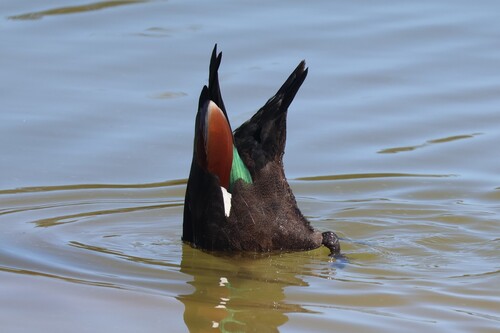
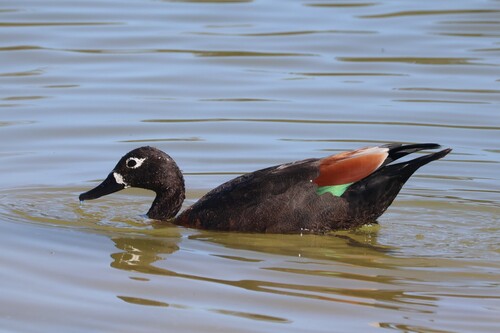
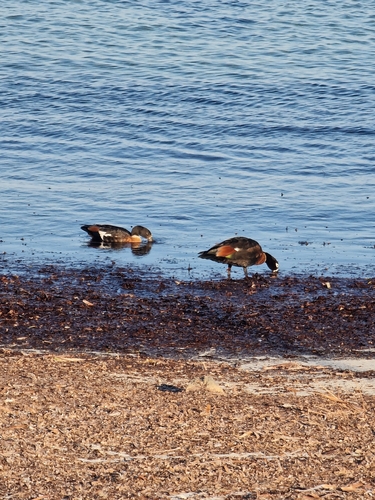
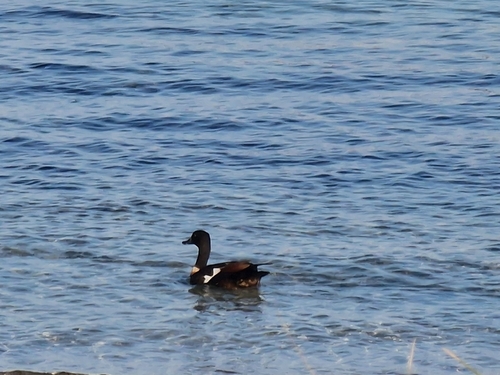
The males are mostly dark, with a chestnut breast. They have white neck collars and dark green heads. The females are similar, but they have white around the eyes and are smaller. Both males and females have chestnut and black wings with a green speculum, and show some white on their wings during flight. The downy young are white with a brown crown and brown stripes from crown to tail. Juvenile males are duller than the adults and also lack a white collar, while juvenile females have a lot more white on their excluding their crown.
Text from Wikipedia, licensed CC BY-SA 4.0.
When to see the Australian Shelduck
One bar for each month, and every month is filled: this bird is recorded here in all twelve. The wide bar is February, the month with the most records.
Where to see the Australian Shelduck
The map shades 2 countries with regular records, and 6 more in a lighter tone where the bird turns up only as a stray. Everything unshaded has no records. Countries are listed below the map.
Recorded as a rare visitor in Sweden, United Kingdom, France, Italy, Czechia, Germany.
About the Australian Shelduck
The Australian shelduck, also known as the chestnut-breasted shelduck or mountain duck, is a shelduck, a group of large goose-like ducks part of the bird family Anatidae. The genus name Tadorna comes from Celtic roots and means "pied waterfowl". They have a striking chestnut-coloured breast and black body. They are protected under the National Parks and Wildlife Act 1974.
Text adapted from Wikipedia, licensed CC BY-SA 4.0.
Easily confused with
 Paradise ShelduckTadorna variegataThe paradise shelduck is a colourful, large-bodied species of duck that differs in features depending on the sex.
 Ruddy ShelduckTadorna ferrugineaThe ruddy shelduck grows to a length of 58 to 70 cm (23 to 28 in) and has a 110–135 cm (43–53 in) wingspan.
 South African ShelduckTadorna canaAdult South African shelducks have ruddy bodies and wings strikingly marked with black, white and green.
Side by side: Australian Shelduck vs Common Shelduck · Australian Shelduck vs Ruddy Shelduck · Australian Shelduck vs Spur-winged Goose · Australian Shelduck vs Paradise Shelduck · Australian Shelduck vs South African Shelduck
Learn the Australian Shelduck in the BeakBrain App
Photo and call practice. Coming soon to iPhone and Android.
Play today's Daily BirdEvery photo and recording on this page is credited to its author under the licence shown. Spotted a problem with this page, or have a better photo? Contribute.