Learn what every symbol on the card means.Full credits and sources at beakbrain.com/symbols
 ForestScrapeMedium · 172 g


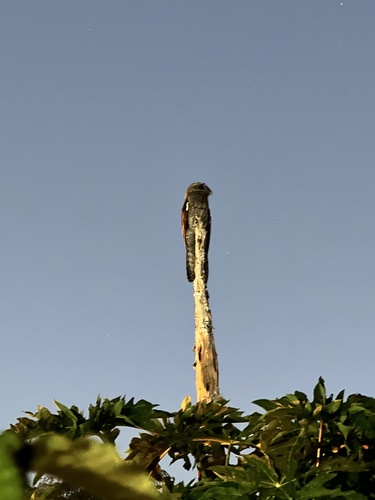
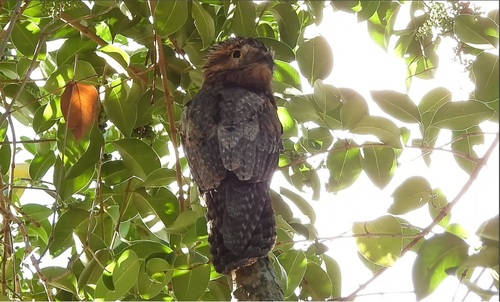


What the Common Potoo sounds like


ID tip
Common potoos are 34–38 cm (13–15 in) long with mottled red-brown, white, black, and grey cryptic plumage. This disruptive coloration allows the potoo to camouflage into branches. The sexes appear similar, and cannot be distinguished upon observation. The eyes can appear as giant black dots with a small yellow ring, or as giant yellow irises with small pupils due to voluntary pupil constriction. The potoo has two or three slits in the eyelid so that it can see when the eyelids are closed; these notches are always open.
Text from Wikipedia, licensed CC BY-SA 4.0.
When to see the Common Potoo
One bar for each month, and every month is filled: this bird is recorded here in all twelve. The wide bar is October, the month with the most records.
Where to see the Common Potoo
The map shades 16 countries with regular records. Everything unshaded has no records. Countries are listed below the map.
About the Common Potoo
The common potoo, or kakuy, or urutau is one of seven species of birds within the genus Nyctibius. It is notable for its large, yellow eyes and a wide mouth. Potoos are nocturnal and are related to nightjars and frogmouths. They lack the characteristic bristles around the mouths of true nightjars.
Text adapted from Wikipedia, licensed CC BY-SA 4.0.
Easily confused with
 Great PotooNyctibius grandisThe great potoo has a large head in relation to its body, large, dark brown eyes, and a short but broad beak.
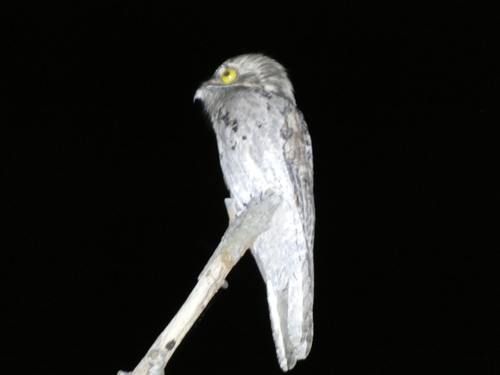 Northern PotooNyctibius jamaicensisIt is a fairly large bird with a length of 38–46 centimetres.
 Long-tailed PotooNyctibius aethereusThe long-tailed potoo is 42 to 58 cm (17 to 23 in) long and weighs 280 to 447 g (9.9 to 15.8 oz).
Side by side: Common Potoo vs Great Potoo · Common Potoo vs Northern Potoo
Learn the Common Potoo in the BeakBrain App
Photo and call practice. Coming soon to iPhone and Android.
Play today's Daily BirdEvery photo and recording on this page is credited to its author under the licence shown. Spotted a problem with this page, or have a better photo? Contribute.