Learn what every symbol on the card means.Full credits and sources at beakbrain.com/symbols
 ForestCavity nestLarge · 547 g




What the Great Potoo sounds like


ID tip
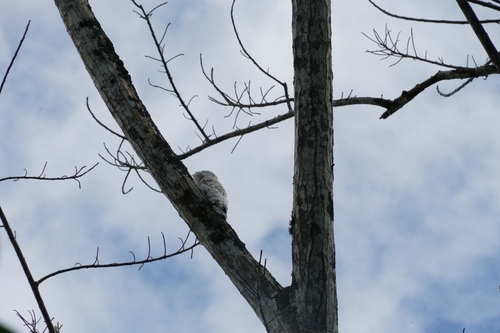
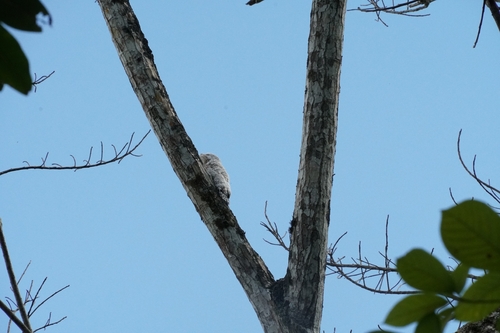
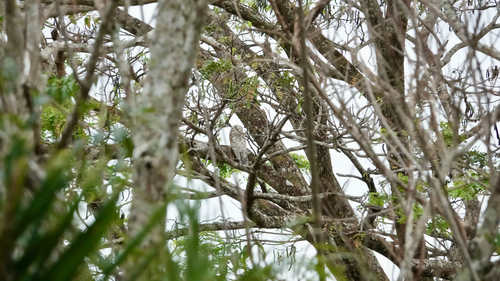
The great potoo has a large head in relation to its body, large, dark brown eyes, and a short but broad beak. Their wings are elliptical in shape, their tail is elongated, and their feathers are white, gray, black, and burgundy. The tail colors match with that of the rest of the body, with the exception of white bars that can be seen going across the tail laterally. Range in Mass: 360 to 650 g (13 to 23 oz) Range in Length: 480 to 600 mm (19 to 24 in) Range in wingspan: 700 to 804 mm (27.6 to 31.7 in) Average Wingspan: 734.8 mm (28.93 in)
Text from Wikipedia, licensed CC BY-SA 4.0.
When to see the Great Potoo
One bar for each month, and every month is filled: this bird is recorded here in all twelve. The wide bar is October, the month with the most records.
Where to see the Great Potoo
The map shades 16 countries with regular records, and 1 more in a lighter tone where the bird turns up only as a stray. Everything unshaded has no records. Countries are listed below the map.
Recorded as a rare visitor in Paraguay.
About the Great Potoo
The great potoo or grand potoo is the largest potoo species and is widely distributed in Central and South America.
Text adapted from Wikipedia, licensed CC BY-SA 4.0.
Easily confused with
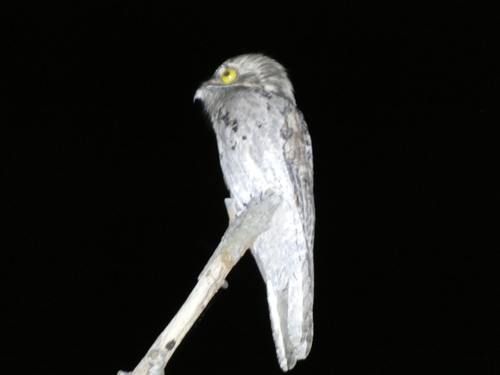 Northern PotooNyctibius jamaicensisIt is a fairly large bird with a length of 38–46 centimetres.
 Common PotooNyctibius griseusCommon potoos are 34–38 cm (13–15 in) long with mottled red-brown, white, black, and grey cryptic plumage.
 Long-tailed PotooNyctibius aethereusThe long-tailed potoo is 42 to 58 cm (17 to 23 in) long and weighs 280 to 447 g (9.9 to 15.8 oz).
Side by side: Common Potoo vs Great Potoo · Great Potoo vs Northern Potoo
Learn the Great Potoo in the BeakBrain App
Photo and call practice. Coming soon to iPhone and Android.
Play today's Daily BirdEvery photo and recording on this page is credited to its author under the licence shown. Spotted a problem with this page, or have a better photo? Contribute.