Learn what every symbol on the card means.Full credits and sources at beakbrain.com/symbols
 WetlandPlatform nestLarge · 655 g





What the Caspian Tern sounds like


ID tip
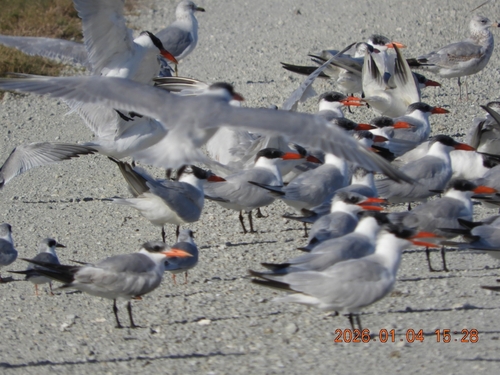
It is the world's largest tern with a length of 48–60 cm (19–24 in), a wingspan of 127–145 cm (50–57 in) and a weight of 530–782 g (18.7–27.6 oz). Adult birds have black legs, and a long thick red-orange bill with a small black tip. They have a white head with a black cap and white neck, belly, and tail. The upper wings and back are pale grey; the underwings are pale with dark primary feathers. In-flight, the tail is less forked than other terns, and wingtips are black on the underside.
Text from Wikipedia, licensed CC BY-SA 4.0.
When to see the Caspian Tern
One bar for each month. Filled bars are the 8 months with records; pale bars are months with none. The wide bar is May, the month with the most records.
Where to see the Caspian Tern
The map shades 151 countries with regular records, and 9 more in a lighter tone where the bird turns up only as a stray. Everything unshaded has no records. Countries are listed below the map.
Recorded as a rare visitor in Iceland, Lebanon, Turkmenistan, Congo - Brazzaville, Liberia, Mayotte, French Guiana, St. Kitts & Nevis, Luxembourg.
About the Caspian Tern
The Caspian tern is the world's largest species of tern, with a subcosmopolitan but scattered distribution. Despite its extensive range, it is monotypic of its genus, and has no accepted subspecies. The genus name is from Ancient Greek hudro-, "water-", and Latin progne, "swallow". The specific caspia is from Latin and, like the English name, refers to the Caspian Sea.
Text adapted from Wikipedia, licensed CC BY-SA 4.0.
Easily confused with
 Common TernSterna hirundoThe nominate subspecies of the common tern is 31–35 cm (12–14 in) long, including a 6–9 cm (2.4–3.5 in) fork in the tail, with a 77–98 cm (30–39 in) wingspan.
 Common GullLarus canusAdult common gulls are 40–46 cm (16–18 in) long and a wingspan of 100–115 cm (39–45 in), noticeably smaller than the herring gull and slightly smaller than the ring-billed gull.
 California GullLarus californicusAdults are similar in appearance to the herring gull, but with brown eyes, yellow legs, and a more rounded head.
Side by side: Caspian Tern vs Common Tern · Caspian Tern vs Common Gull · California Gull vs Caspian Tern
Learn the Caspian Tern in the BeakBrain App
Photo and call practice. Coming soon to iPhone and Android.
Play today's Daily BirdEvery photo and recording on this page is credited to its author under the licence shown. Spotted a problem with this page, or have a better photo? Contribute.