Learn what every symbol on the card means.Full credits and sources at beakbrain.com/symbols
 CoastalPlatform nestLarge · 413 g


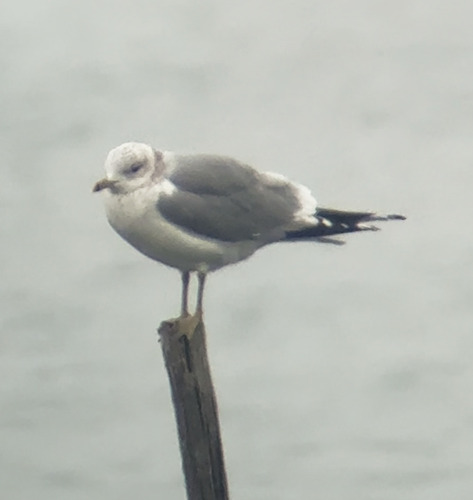
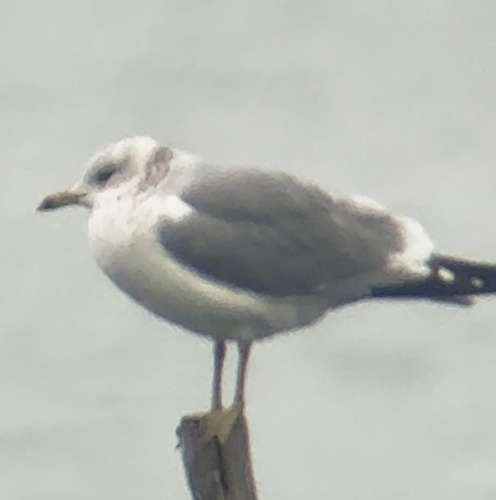
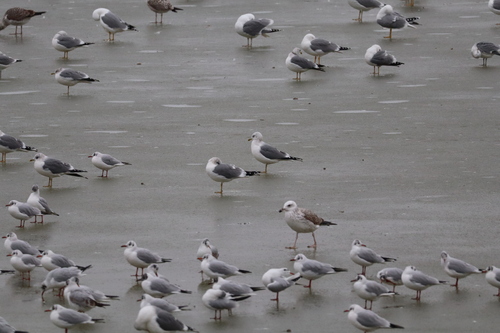

What the Common Gull sounds like


ID tip
Adult common gulls are 40–46 cm (16–18 in) long and a wingspan of 100–115 cm (39–45 in), noticeably smaller than the herring gull and slightly smaller than the ring-billed gull. It is further distinguished from the ring-billed gull by its shorter, more tapered bill, which is a more greenish shade of yellow and is unmarked during the breeding season. The body is grey above and white below. The legs are yellow in breeding season, becoming duller in the winter.
Text from Wikipedia, licensed CC BY-SA 4.0.
When to see the Common Gull
One bar for each month, and every month is filled: this bird is recorded here in all twelve. The wide bar is June, the month with the most records.
Where to see the Common Gull
The map shades 72 countries with regular records, and 7 more in a lighter tone where the bird turns up only as a stray. Everything unshaded has no records. Countries are listed below the map.
Recorded as a rare visitor in India, Australia, Senegal, French Guiana, Tunisia, Syria, Gibraltar.
About the Common Gull
The common gull is a gull that breeds in cool temperate regions of the Palearctic from Iceland and Scotland east to Kamchatka in the Russian Far East. Most common gulls migrate further south in winter, reaching the Mediterranean Sea, the southern Caspian Sea, and the seas around China and Japan; northwest European populations are at least partly resident. The closely related short-billed gull was formerly often included in this species, which was then sometimes known collectively as "mew gull".
Text adapted from Wikipedia, licensed CC BY-SA 4.0.
Easily confused with
 California GullLarus californicusAdults are similar in appearance to the herring gull, but with brown eyes, yellow legs, and a more rounded head.
 Western GullLarus occidentalisThe western gull is a large white-headed gull that lives on the west coast of North America and the Pacific Ocean.
 Yellow-legged GullLarus michahellisThe yellow-legged gull is a large gull, though the size does vary, with the smallest females being scarcely larger than a common gull and the largest males being roughly the size of a great black-backed gull.
Side by side: Common Gull vs Great Black-backed Gull · Caspian Tern vs Common Gull · California Gull vs Common Gull · Common Gull vs Yellow-legged Gull
Learn the Common Gull in the BeakBrain App
Photo and call practice. Coming soon to iPhone and Android.
Play today's Daily BirdEvery photo and recording on this page is credited to its author under the licence shown. Spotted a problem with this page, or have a better photo? Contribute.