Learn what every symbol on the card means.Full credits and sources at beakbrain.com/symbols
 WetlandScrapeMedium · 288 g



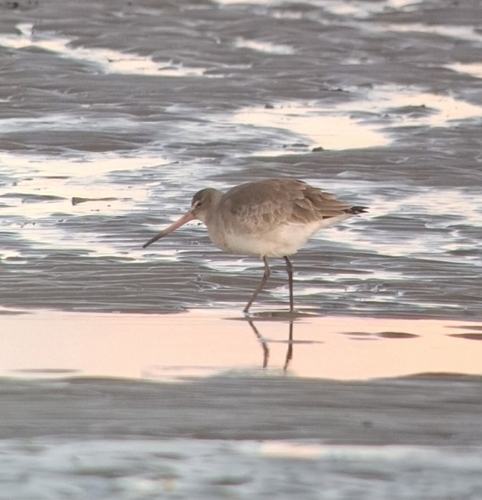
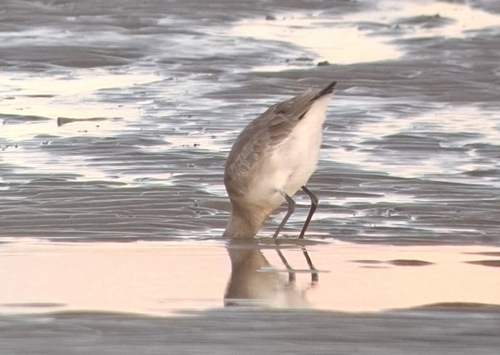
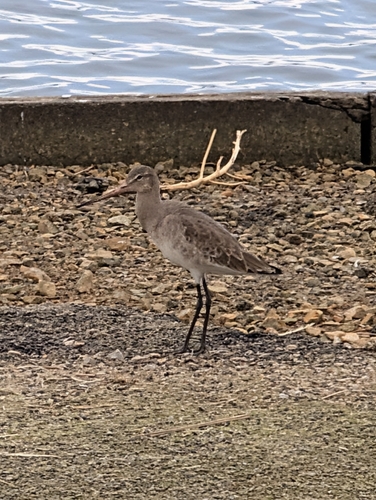
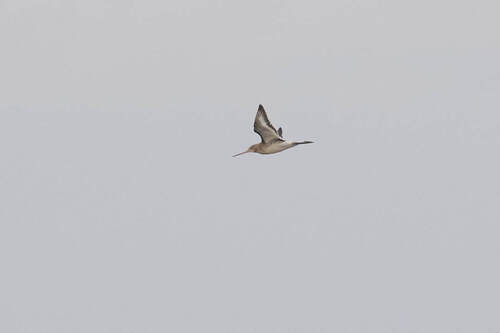
What the Black-tailed Godwit sounds like


ID tip
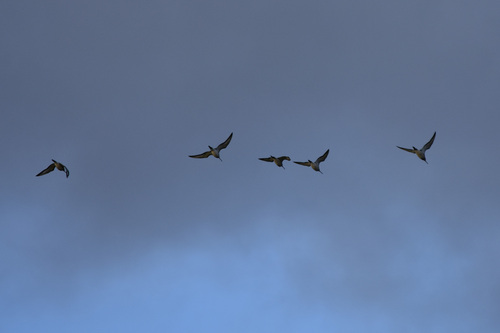
The black-tailed godwit is a large wader with long bill (7.5 to 12 cm (3.0 to 4.7 in) long), neck and legs. During the breeding season, the bill has a yellowish or orange-pink base and dark tip; the base is pink in winter. The legs are dark grey, brown or black. The sexes are similar, but in breeding plumage, they can be separated by the male's brighter, more extensive orange breast, neck and head. In winter, adult black-tailed godwits have a uniform brown-grey breast and upperparts (in contrast to the bar-tailed godwit's streaked back).
Text from Wikipedia, licensed CC BY-SA 4.0.
When to see the Black-tailed Godwit
One bar for each month, and every month is filled: this bird is recorded here in all twelve. The wide bar is April, the month with the most records.
Where to see the Black-tailed Godwit
The map shades 129 countries with regular records, and 11 more in a lighter tone where the bird turns up only as a stray. Everything unshaded has no records. Countries are listed below the map.
Recorded as a rare visitor in United States, Canada, Benin, Libya, Lebanon, Micronesia, Dominican Republic, Trinidad & Tobago, Macao SAR China, Luxembourg, Marshall Islands.
About the Black-tailed Godwit
The black-tailed godwit is a large, long-legged, long-billed shorebird first described by Carl Linnaeus in 1758. It is a member of the godwit genus, Limosa. There are four subspecies, all with orange head, neck and chest in breeding plumage and dull grey-brown winter coloration, and distinctive black and white wingbar at all times.
Text adapted from Wikipedia, licensed CC BY-SA 4.0.
Easily confused with
 Marbled GodwitLimosa fedoaThe total length is 40–50 cm (16–20 in), including a large bill of 8–13 cm (3.1–5.1 in), and wingspan is 70–88 cm (28–35 in).
 Bar-tailed GodwitLimosa lapponicaThe bar-tailed godwit is a relatively short-legged species of godwit.
 Hudsonian GodwitLimosa haemasticaAdults have long dark legs and a long pink bill with a slight upward curve and dark at the tip.
Side by side: Black-tailed Godwit vs Marbled Godwit · Bar-tailed Godwit vs Black-tailed Godwit · Black-tailed Godwit vs Hudsonian Godwit
Learn the Black-tailed Godwit in the BeakBrain App
Photo and call practice. Coming soon to iPhone and Android.
Play today's Daily BirdEvery photo and recording on this page is credited to its author under the licence shown. Spotted a problem with this page, or have a better photo? Contribute.