Learn what every symbol on the card means.Full credits and sources at beakbrain.com/symbols
 WetlandScrapeLarge · 357 g


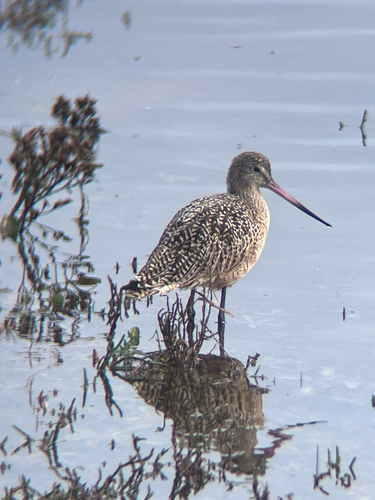
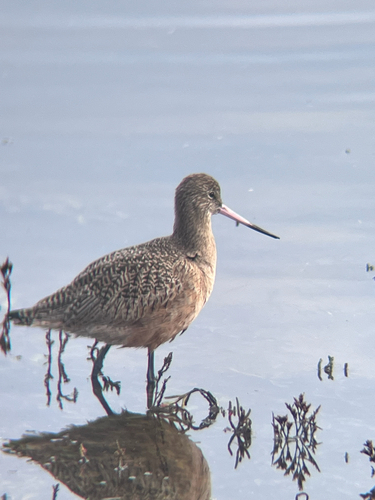
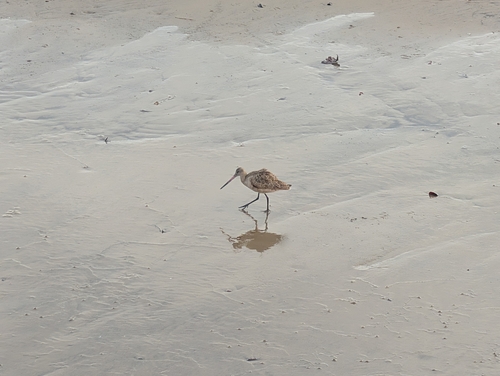
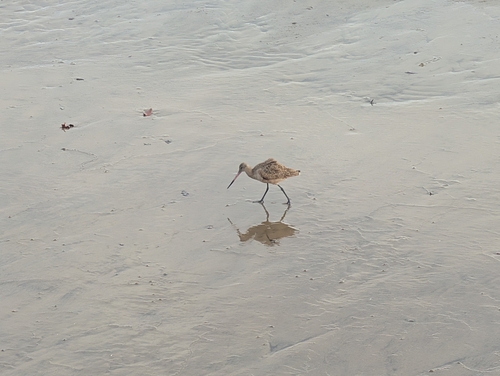
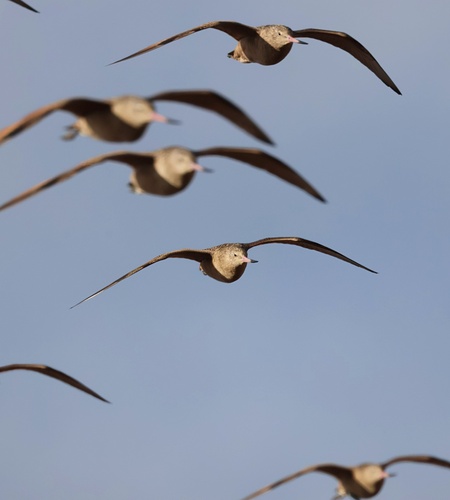
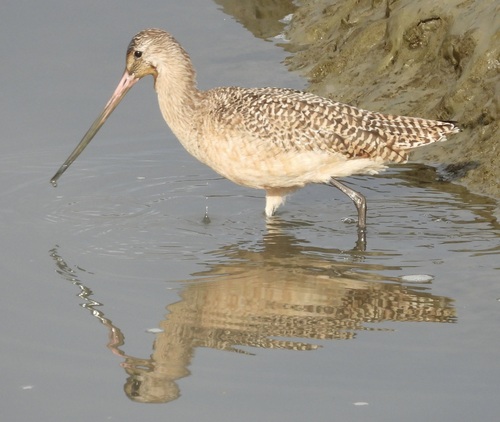

ID tip
The total length is 40–50 cm (16–20 in), including a large bill of 8–13 cm (3.1–5.1 in), and wingspan is 70–88 cm (28–35 in). Body mass can vary from 240 to 520 g (8.5 to 18.3 oz). The average weight of 40 males was 326 g (11.5 oz) and that of 45 females was 391 g (13.8 oz). Bill length is from 73.9 to 131 mm (2.91 to 5.16 in). Among all the members of the sandpiper family, only the curlews attain sizes that significantly exceed this species. Adults have long blue-grey legs and a very long pink bill with a slight upward curve and dark at the tip.
Text from Wikipedia, licensed CC BY-SA 4.0.
When to see the Marbled Godwit
One bar for each month, and every month is filled: this bird is recorded here in all twelve. The wide bar is April, the month with the most records.
Where to see the Marbled Godwit
The map shades 22 countries with regular records, and 5 more in a lighter tone where the bird turns up only as a stray. Everything unshaded has no records. Countries are listed below the map.
Recorded as a rare visitor in Jamaica, Brazil, Martinique, St. Martin, St. Pierre & Miquelon.
About the Marbled Godwit
The marbled godwit is a large migratory shorebird in the family Scolopacidae. On average, it is the largest of the four species of godwit.
Text adapted from Wikipedia, licensed CC BY-SA 4.0.
Easily confused with
 Black-tailed GodwitLimosa limosaThe black-tailed godwit is a large wader with long bill (7.5 to 12 cm (3.0 to 4.7 in) long), neck and legs.
 Bar-tailed GodwitLimosa lapponicaThe bar-tailed godwit is a relatively short-legged species of godwit.
 Hudsonian GodwitLimosa haemasticaAdults have long dark legs and a long pink bill with a slight upward curve and dark at the tip.
Side by side: Black-tailed Godwit vs Marbled Godwit · Bar-tailed Godwit vs Marbled Godwit · Hudsonian Godwit vs Marbled Godwit
Learn the Marbled Godwit in the BeakBrain App
Photo and call practice. Coming soon to iPhone and Android.
Play today's Daily BirdEvery photo and recording on this page is credited to its author under the licence shown. Spotted a problem with this page, or have a better photo? Contribute.