Learn what every symbol on the card means.Full credits and sources at beakbrain.com/symbols
 WetlandPlatform nestLarge · 412 g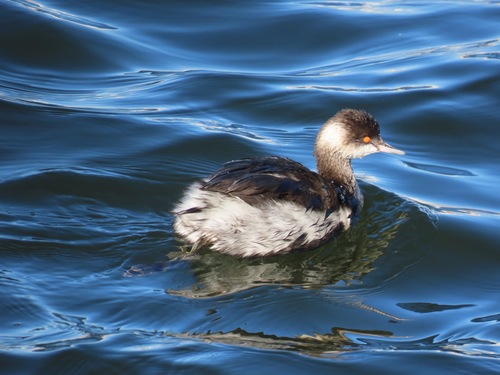

ID tip
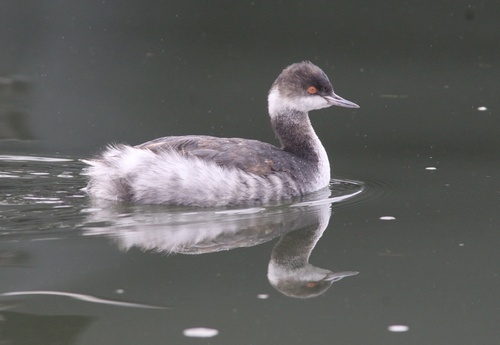
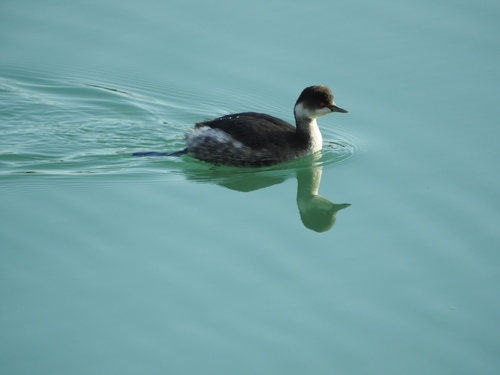
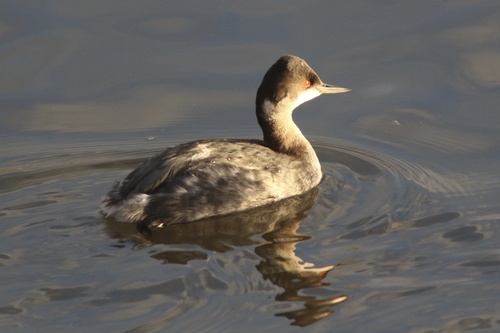
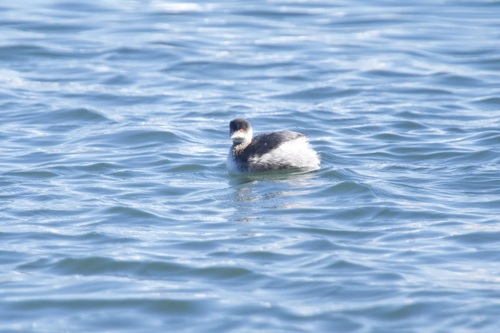
The black-necked grebe usually measures between 28 and 34 centimetres (11 and 13 in) in length and has a wingspan range of 56–60 centimetres (22–24 in) in P. n. nigricollis, and 52–55 centimetres (20–22 in) in P. n. californicus. It weighs 215 to 450 grams (7.6 to 15.9 oz), with males being on average heavier than females. The nominate subspecies in breeding plumage has the head, neck, breast, and upper parts coloured black to blackish brown, with the exception of the ochre-coloured fan of feathers extending behind the eye over the eye-coverts and sides of the nape. Voice: When breeding, the black-necked grebe gives a quiet "ooeek" that ascends in pitch from an already high pitch. This call is also used as a territorial call, in addition to a low and fast trill, which itself is also used during courtship. Another call is a short "puuii" or "wit". This grebe is silent when it is not the breeding season and when it is feeding or resting.
Text from Wikipedia, licensed CC BY-SA 4.0.
When to see the Black-necked Grebe
One bar for each month. Filled bars are the 11 months with records; pale bars are months with none. The wide bar is April, the month with the most records.
Where to see the Black-necked Grebe
The map shades 95 countries with regular records, and 6 more in a lighter tone where the bird turns up only as a stray. Everything unshaded has no records. Countries are listed below the map.
Recorded as a rare visitor in Finland, Luxembourg, Lesotho, St. Pierre & Miquelon, North Korea, Guernsey.
About the Black-necked Grebe
The black-necked grebe or eared grebe is a member of the grebe family of water birds. It was described in 1831 by Christian Ludwig Brehm. Its breeding plumage features distinctive ochre-coloured feathers which extend behind its eye and over its ear coverts. The rest of the upper parts, including the head, neck, and breast, are coloured black to blackish brown. The flanks are tawny rufous to maroon-chestnut, and the abdomen is white. In its non-breeding plumage, this bird has greyish-black upper parts, including the top of the head and a vertical stripe on the back of the neck. The flanks are also greyish-black. The rest of the body is a white or whitish colour.
Text adapted from Wikipedia, licensed CC BY-SA 4.0.
Easily confused with
 Red-necked GrebePodiceps grisegenaThe red-necked grebe is a medium-large grebe, smaller than the great crested grebe of Eurasia, and the western and Clark's grebes of North America, but noticeably larger than other northern grebe species.
 Horned GrebePodiceps auritusThe species can be recognised by its orange-red and black breeding plumage, its black and white non-breeding plumage, and its characteristic "horns".
 Great GrebePodiceps majorThis is a very large grebe, with proportions more like a goose or a cormorant than a typical grebe.
Side by side: Black-necked Grebe vs Great Crested Grebe · Black-necked Grebe vs Horned Grebe · Black-necked Grebe vs Red-necked Grebe · Black-necked Grebe vs Great Grebe
Learn the Black-necked Grebe in the BeakBrain App
Photo and call practice. Coming soon to iPhone and Android.
Play today's Daily BirdEvery photo and recording on this page is credited to its author under the licence shown. Spotted a problem with this page, or have a better photo? Contribute.