Learn what every symbol on the card means.Full credits and sources at beakbrain.com/symbols
 WetlandPlatform nestLarge · 453 g


What the Horned Grebe sounds like

ID tip
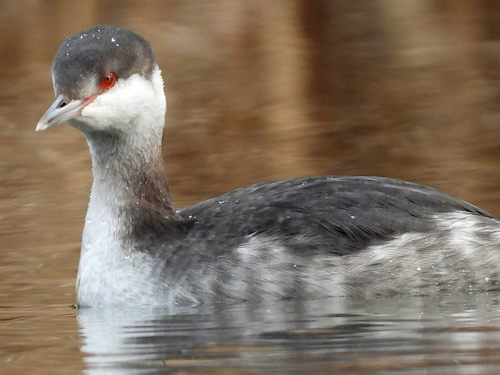
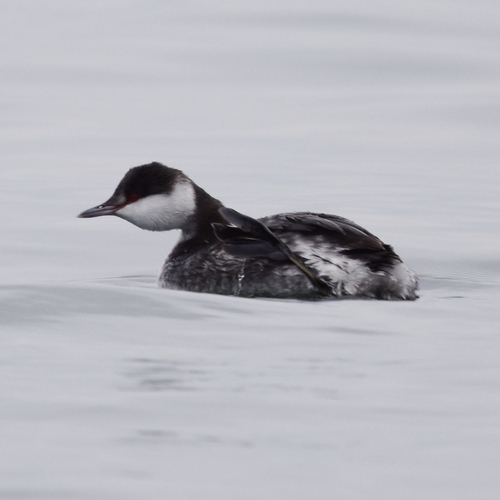
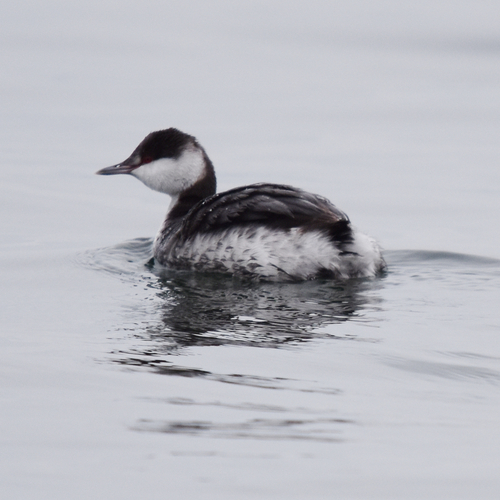
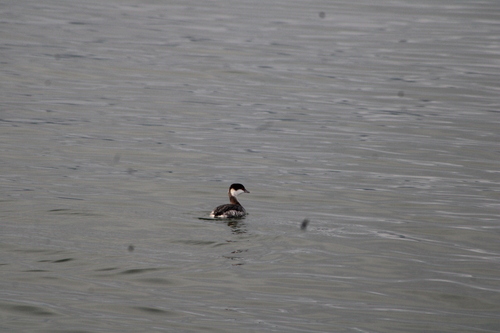
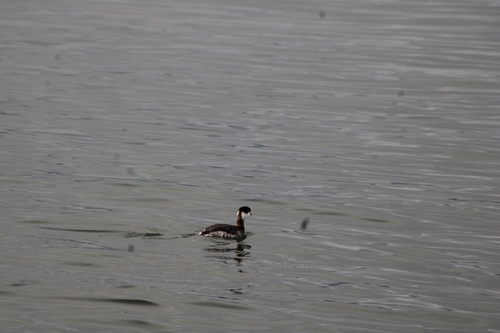
The species can be recognised by its orange-red and black breeding plumage, its black and white non-breeding plumage, and its characteristic "horns". It is 31–38 cm (12–15 in) long, has a wingspan 55–74 cm (22–29 in) wide and weighs 300–570 g (11–20 oz). It has a moderately long neck, flat forehead and a rear crown of black feathers. Its beak is straight and pointed, with a white tip. The breeding plumage has bright erectable "horns", black fan-shaped cheek feathers and an overall red-and-black colour. Voice: Young begin calling for begging purposes in a slightly trilled peeping noise, similar to that of a domestic chick. As they mature, their song changes to a more adult-like chittering. Their typical advertising call is loud and nasally "aaarrh" descending in a pitch and ending in a trill.
Text from Wikipedia, licensed CC BY-SA 4.0.
When to see the Horned Grebe
One bar for each month. Filled bars are the 8 months with records; pale bars are months with none. The wide bar is April, the month with the most records.
Where to see the Horned Grebe
The map shades 58 countries with regular records, and 6 more in a lighter tone where the bird turns up only as a stray. Everything unshaded has no records. Countries are listed below the map.
Recorded as a rare visitor in India, Luxembourg, Pakistan, Moldova, North Korea, Bosnia & Herzegovina.
About the Horned Grebe
The horned grebe or Slavonian grebe is a relatively small and threatened species of waterbird in the family Podicipedidae. There are two subspecies, P. a. auritus, which breeds in Eurasia, and P. a. cornutus, which breeds in North America. The Eurasian subspecies is distributed over most of northern Europe and northern Asia, breeding from Iceland east to the Russian Far East. The North American subspecies spans most of Canada and some of the United States. A small population was cited in Greenland in 1973, but is not mapped or further mentioned by subsequent authors.
Text adapted from Wikipedia, licensed CC BY-SA 4.0.
Easily confused with
 Great Crested GrebePodiceps cristatusThe great crested grebe is the largest species of grebe in the Old World, though some larger species occur in the Americas.
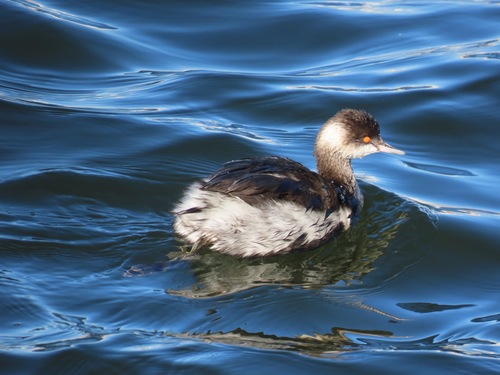 Black-necked GrebePodiceps nigricollisThe black-necked grebe usually measures between 28 and 34 centimetres (11 and 13 in) in length and has a wingspan range of 56–60 centimetres (22–24 in) in P. n. nigricollis, and 52–55 centimetres (20–22 in) in P. n. californicus.
 Red-necked GrebePodiceps grisegenaThe red-necked grebe is a medium-large grebe, smaller than the great crested grebe of Eurasia, and the western and Clark's grebes of North America, but noticeably larger than other northern grebe species.
Side by side: Horned Grebe vs Pied-billed Grebe · Great Crested Grebe vs Horned Grebe · Black-necked Grebe vs Horned Grebe · Horned Grebe vs Red-necked Grebe
Learn the Horned Grebe in the BeakBrain App
Photo and call practice. Coming soon to iPhone and Android.
Play today's Daily BirdEvery photo and recording on this page is credited to its author under the licence shown. Spotted a problem with this page, or have a better photo? Contribute.